
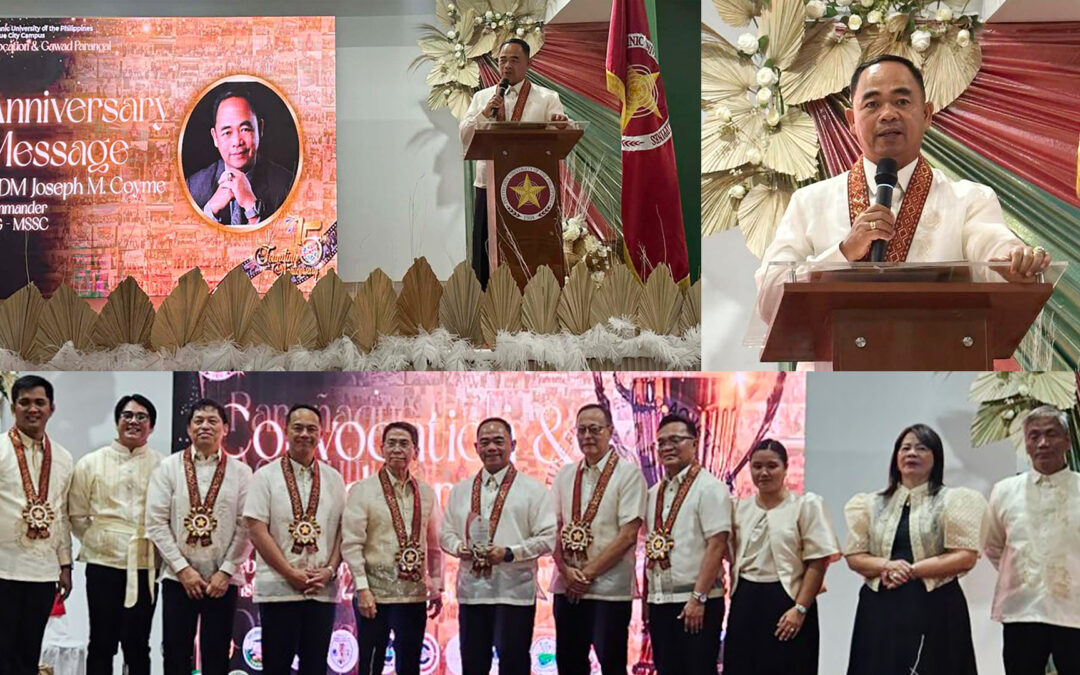
Anniversary Message
Polytechnic University of the Philippines – 15th Founding Anniversary
VADM JOSEPH M COYME PCG (Ret.)
28 March 2026 at PUP
Distinguished officials of the Polytechnic University of the Philippines, respected faculty members, proud parents, awardees, dear students, ladies and gentlemen—good morning.
Allow me to begin with the words of Nelson Mandela, who once said:
“Education is the most powerful weapon which you can use to change the world.”
It is both an honor and a privilege to stand before you today as you celebrate your 15th Founding Anniversary, anchored on the meaningful theme: “Honoring Roots for a New Horizon: Celebrating Growth and Innovation of Transformative Education for a Sustainable Future.”
This theme resonates deeply with me—not only as a former maritime safety administrator, but as someone who has spent decades navigating the complexities of safeguarding lives at sea and strengthening systems that protect our nation.
Fifteen years may seem young for an institution, but it is more than enough time to build roots—roots of discipline, excellence, resilience, and purpose. And today, we celebrate how those roots have grown into a dynamic force shaping minds and transforming lives.
Throughout my years in service with the Philippine Coast Guard, particularly as Commander of the Maritime Safety Services Command, I witnessed firsthand how education—when grounded in real-world application—becomes a powerful tool for national development.
Maritime safety is not just about ships, regulations, or technology. It is about people. It is about decisions made under pressure. It is about innovation in the face of uncertainty.
We worked across critical areas—vessel safety, search and rescue, maritime casualty investigation, navigational safety, port state control, and even recreational safety. Each of these demanded not only technical expertise, but also critical thinking, adaptability, and integrity—qualities that institutions like yours help cultivate.
Allow me to share a simple truth from my experience:
The future belongs not just to the educated—but to the adaptable, the innovative, and the purposeful.
Today, we live in a time where challenges are no longer isolated. Climate change, maritime security threats, environmental protection, and economic sustainability are all interconnected. In an archipelagic country like the Philippines, our seas are not just boundaries—they are lifelines.
And yet today, we are reminded of how interconnected the world truly is.
The ongoing crisis in the Middle East has triggered a sharp increase in global fuel prices. For a maritime nation like ours—where fuel drives transportation, logistics, fisheries, and trade—the effects are immediate and deeply felt. From higher transport fares to rising prices of basic goods, every Filipino family is affected.
In the maritime sector, higher fuel costs impact vessel operations, safety decisions, and even emergency response capabilities. It reminds us that global disruptions can quickly become local realities.
So the question is: How do we respond?
From my experience in maritime safety and governance, the answer is not panic—but preparation, adaptation, and innovation.
At the national level, we strengthen systems—improving vessel traffic management, optimizing routes, and reducing inefficiencies. This is one of the reasons why, in my current role as President and CEO of the Philippine Archipelagic Sea Lanes Center Inc., we are advancing initiatives such as Vessel Traffic Monitoring Systems in key maritime choke points. Efficient navigation reduces fuel consumption, enhances safety, and supports economic resilience.
But beyond government efforts, there is a powerful role for every Filipino—and especially for institutions like yours.
Let me offer some practical ways to mitigate the impact of global economic disruptions:
First, efficiency in daily life.
Simple actions—carpooling, using public transportation, conserving electricity, and minimizing waste—may seem small, but collectively they create significant impact.
Second, innovation at the academic level.
Universities like the Polytechnic University of the Philippines can lead in developing research on renewable energy, sustainable transport systems, and fuel-efficient technologies. Encourage student-led solutions—because innovation often begins in classrooms.
Third, skills aligned with national needs.
Equip students not just with theoretical knowledge, but with practical competencies in logistics, engineering, data analysis, and sustainability. These are critical in navigating economic disruptions.
Fourth, strengthening local resilience.
Support local industries, promote community-based solutions, and reduce overdependence on external supply chains whenever possible.
And finally, a mindset of adaptability.
In maritime operations, we always prepare for changing conditions. The same principle applies to life—those who adapt quickly are those who endure and succeed.
Seven months after my retirement from active service, I took on a new challenge with PASLCI. In a short span of time, we have completed a six-year strategic plan and are now implementing forward-looking initiatives that support safe, efficient, and sustainable maritime navigation.
Why do I share this with you?
Because it reflects what your theme speaks of—growth rooted in purpose, and innovation driven by vision, especially in times of uncertainty.
To the students here today:
You are the new horizon.
But horizons are not reached by chance. They are pursued with discipline, shaped by hardship, and sustained by purpose.
Do not be discouraged by global challenges. Instead, see them as opportunities to think differently, to innovate, and to lead.
To the faculty and administrators:
You are the stewards of transformation.
Continue to produce graduates who are not only competent—but resilient, resourceful, and forward-thinking. Because the future will demand not just knowledge—but solutions.
And to the awardees of the Gawad Parangal:
You represent excellence in action.
Let your achievements inspire not only pride—but responsibility. The nation needs leaders who can navigate both calm seas and turbulent times.
As we look toward the future, we must ask ourselves:
What kind of horizon are we building?
One that is sustainable? Inclusive? Resilient?
In the maritime sector, we plan for storms. Today’s global economic disruptions are reminders that storms are not always natural—they can be geopolitical, economic, or technological.
But with strong roots and clear vision—we will endure.
Let me close with the words of Peter Drucker:
“The best way to predict the future is to create it.”
Strong roots anchor us—but it is our ability to adapt and to act that keeps us moving forward.
The journey ahead will not always be easy. But if your foundation is built on knowledge, integrity, and purpose—you will not drift.
You will lead.
On this 15th anniversary of the Polytechnic University of the Philippines, I extend my heartfelt congratulations to everyone who has contributed to its growth and success.
May you continue to inspire innovation, uphold excellence, and shape generations who will not only adapt to the future—but define it.
Maraming salamat, at mabuhay po tayong lahat.
Inspiring Message and motivating factors not only based on the maritime aspect but how we individual respond to the challenges we may encounter in our lives. At least one may always be conscious, calm, and never allow the panic situation overule us.