
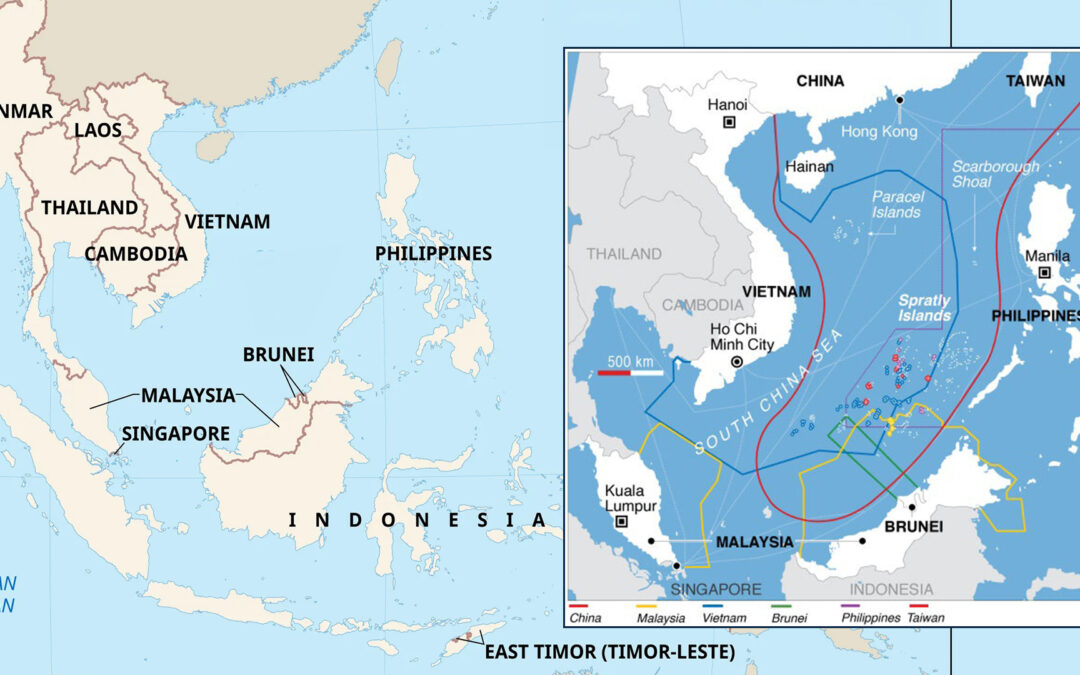
Why Distance Does Not Diminish Sovereignty — and Why the Kalayaan Island Group Matters
Recent remarks suggesting that the Philippines should relinquish the Kalayaan Island Group (KIG) on the ground that parts of it lie outside the country’s exclusive economic zone (EEZ) reflect a fundamental misunderstanding of international law. Such claims imply that sovereignty over territory depends on proximity to a state’s main archipelago or its EEZ coverage. This proposition is incorrect. In fact, numerous member states of the United Nations Convention on the Law of the Sea (UNCLOS) possess sovereign territories located far beyond their primary baselines and EEZs, without any diminution of their legal status.
This article examines established state practice under UNCLOS and explains why distance from an EEZ does not negate sovereignty—particularly in the case of the Kalayaan Island Group.
Sovereignty and the EEZ Are Distinct Legal Concepts
UNCLOS clearly distinguishes between sovereignty over land territory and maritime entitlements derived from that territory. Sovereignty over land and islands is determined by historical title, effective occupation, administration, and recognition under international law.¹ Maritime zones—such as the territorial sea, EEZ, and continental shelf—are generated from land territory; they do not create or extinguish sovereignty themselves.²
An EEZ is a functional maritime zone extending up to 200 nautical miles from baselines, within which a coastal state enjoys sovereign rights for economic purposes, not full sovereignty comparable to land territory or the territorial sea.³ Consequently, the location of an island outside a state’s primary EEZ has no legal bearing on the validity of that state’s sovereignty over the island.
State Practice: UNCLOS Members with Remote Sovereign Territories
International practice overwhelmingly confirms that states may—and often do—own territory far from their main archipelagos or continental landmasses.
United States
The United States exercises undisputed sovereignty over Guam, the Northern Mariana Islands, and American Samoa—territories thousands of kilometers from the U.S. mainland. Each of these territories generates its own maritime zones under UNCLOS principles, despite their remoteness.⁴
France
France maintains sovereignty over overseas territories such as French Polynesia, New Caledonia, Réunion, and Martinique. These distant islands are the reason France possesses one of the world’s largest EEZs, spanning multiple oceans. Their legitimacy has never depended on proximity to metropolitan France.⁵
United Kingdom
British sovereignty over territories such as the Falkland Islands and South Georgia—located far from the British Isles—demonstrates that distance and geographic separation do not nullify territorial claims, even where disputes exist.⁶
Australia
Australia’s sovereignty over Christmas Island, Norfolk Island, and the Cocos (Keeling) Islands further illustrates that remote territories remain integral parts of a state under international law.⁷
These examples demonstrate a settled principle: UNCLOS does not require territorial contiguity, EEZ overlap, or geographic proximity for sovereignty to exist.
UNCLOS Article 121 and the Kalayaan Island Group
Under Article 121 of UNCLOS, islands capable of sustaining human habitation or economic life of their own are entitled to generate maritime zones, including an EEZ and continental shelf.² Crucially, this provision presupposes that the island is land territory first. Its distance from a mainland or archipelago is irrelevant.
Pag-asa Island and other features within the Kalayaan Island Group meet the criteria of land territory under Philippine law and international standards. Philippine sovereignty over KIG is affirmed by:
Presidential Decree No. 1596 (1978), which formally incorporated the KIG into Philippine territory;
Republic Act No. 9522 (2009), which placed the KIG under the “regime of islands” consistent with UNCLOS; and
Republic Act No. 12064 (Philippine Maritime Zones Act), which reiterates Philippine jurisdiction and maritime rights arising from these territories.⁸
None of these legal foundations hinge on whether the KIG lies within 200 nautical miles of the main Philippine archipelago.
The Danger of Conflating EEZ Limits with Sovereignty
The suggestion that the Philippines should “give up” KIG because of EEZ considerations conflates economic maritime entitlements with territorial sovereignty. This conflation has no basis in UNCLOS, state practice, or jurisprudence. If accepted, it would logically compel many states to abandon long-held overseas territories—an outcome plainly inconsistent with international law and reality.
More critically, relinquishing KIG would undermine Philippine constitutional principles, weaken the country’s strategic position in the West Philippine Sea, and set a dangerous precedent that territorial rights may be surrendered simply due to distance or external pressure.
Conclusion
Yes, UNCLOS member states routinely possess sovereign territory outside their main EEZs or far from their primary baselines. This is lawful, established, and uncontroversial. Sovereignty over land does not depend on EEZ measurements; rather, EEZs flow from sovereignty over land.
The Kalayaan Island Group’s distance from the Philippine archipelago does not diminish its status as Philippine territory. To suggest otherwise is to misread UNCLOS, disregard state practice, and risk eroding the very foundations of national sovereignty.
Footnotes
Brownlie, I., Principles of Public International Law, 7th ed.
United Nations Convention on the Law of the Sea (UNCLOS), Art. 121.
UNCLOS, Arts. 55–57.
Roach, J.A. & Smith, R.W., United States Responses to Excessive Maritime Claims.
Schofield, C., Maritime Political Boundaries of the World.
UK Foreign, Commonwealth & Development Office, Overseas Territories Briefings.
Australian Government, Department of Infrastructure, External Territories Overview.
Presidential Decree No. 1596 (1978); Republic Act No. 9522 (2009); Republic Act No. 12064 (2024).