
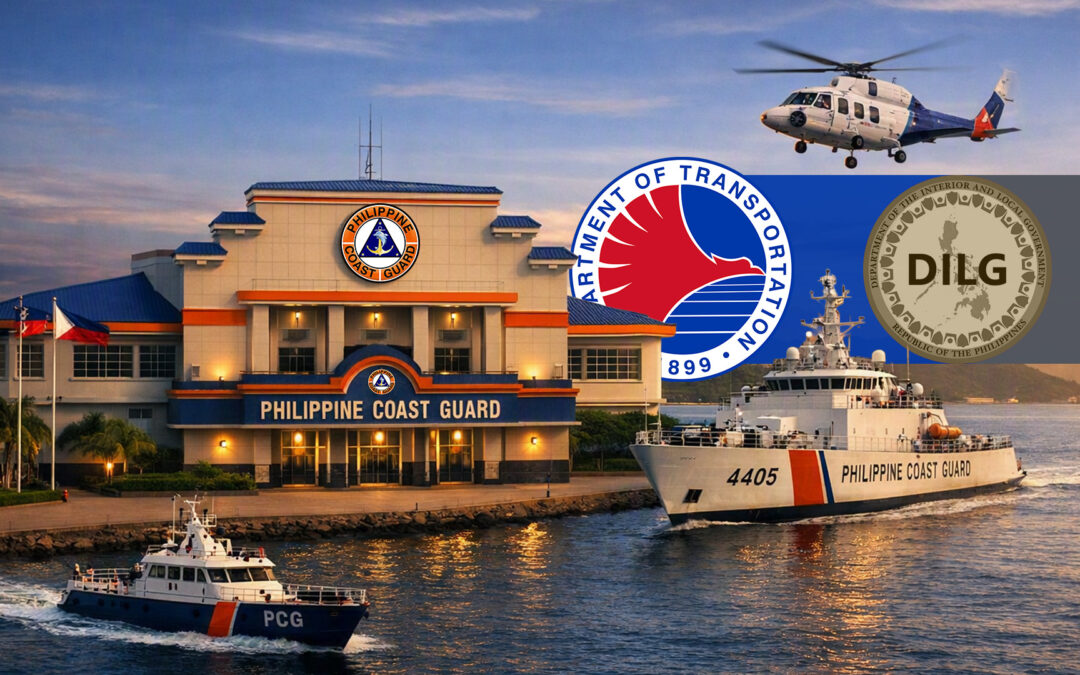
Executive Summary
During the House budget deliberations on the Department of the Interior and Local Government (DILG), Secretary Jonvic Remulla raised the possibility of transferring the Philippine Coast Guard (PCG) and the Bureau of Immigration to the department, a proposal that warrants careful scrutiny because the PCG’s identity and daily work extend far beyond law enforcement. Although the PCG enforces maritime laws, policing is only one part of its mandate. Its everyday work is centered on maritime safety, vessel inspection, search and rescue, marine environmental protection, navigational services, and the implementation of international maritime rules. These are transportation and maritime-administration functions that require technical expertise and constant coordination with ports, shipping regulators, and other agencies under the Department of Transportation (DOTr). Keeping the PCG under DOTr therefore preserves a working operational system. Transferring it to DILG may appear to strengthen law enforcement, but it could instead create overlapping chains of command, weaken specialized oversight, and blur the PCG’s valuable civilian character in the West Philippine Sea.
The following considerations make a compelling case for maintaining the current institutional arrangement:
1. Maritime Governance, Not Internal Policing
The DILG primarily supervises local governments and internal security agencies such as the Philippine National Police (PNP). In contrast, the PCG’s statutory functions are overwhelmingly maritime and transportation related.
Under Republic Act No. 9993, the PCG is tasked to:
- Enforce maritime safety regulations;
- Conduct port state control inspections;
- Inspect merchant ships and vessels;
- Maintain aids to navigation;
- Operate vessel traffic systems;
- Conduct maritime search and rescue;
- Investigate maritime accidents;
- Enforce marine environmental laws;
- Respond to oil spills and maritime pollution incidents;
- Implement international maritime conventions and treaties.
Taken together, these duties show that the PCG is primarily a maritime governance and safety institution. Law enforcement supports that mission; it does not define it.
The distinction matters in practice. A maritime agency must be able to inspect ships, assess seaworthiness, manage navigation risks, coordinate rescue operations, and respond to pollution incidents as parts of one continuous safety system. Treating the PCG mainly as a police force would separate enforcement from the technical work that tells officers what standards apply, what risks are present, and what corrective action is required.
2. International Maritime Obligations Require Technical Oversight
The PCG serves as one of the Philippines’ principal maritime authorities implementing international conventions administered by the International Maritime Organization (IMO).
Among the conventions and instruments the PCG helps enforce are:
Safety of Life at Sea (SOLAS)
- Vessel safety standards
- Navigation safety
- Shipboard emergency procedures
- Maritime communications
Marine Pollution (MARPOL)
- Prevention of marine pollution
- Oil spill prevention and response
- Waste disposal regulations
International Ship and Port Facility Security (ISPS) Code
- Port security measures
- Ship security inspections
Port State Control (PSC)
The PCG is designated as the Philippines’ sole Port State Control authority under the Tokyo Memorandum of Understanding, inspecting foreign vessels calling at Philippine ports for compliance with international maritime standards.
These specialized regulatory functions naturally align the PCG with DOTr, the Maritime Industry Authority (MARINA), the Philippine Ports Authority (PPA), and the rest of the maritime transportation sector.
Port State Control illustrates why institutional alignment is important. These inspections are not ordinary law-enforcement checks. Officers must understand ship certificates, equipment standards, crew readiness, pollution-prevention requirements, and the circumstances in which a vessel may be detained. The work is also carried out through regional cooperation under the Tokyo Memorandum of Understanding. It is therefore best supported by a department already responsible for transport regulation and maritime policy.
Placing the PCG under DILG would therefore move a highly technical maritime regulator into a department principally designed for local governance and internal security.
3. The PCG Is Part of the Maritime Transportation Safety System
The PCG operates within a transportation ecosystem composed of:
- DOTr
- Maritime Industry Authority (MARINA)
- Philippine Ports Authority (PPA)
- Cebu Port Authority (CPA)
- Civil Aviation Authority of the Philippines (CAAP)
- Office for Transportation Security (OTS)
Together, these agencies ensure:
- Safe movement of vessels
- Passenger safety
- Port security
- Marine environmental protection
- Shipping regulation
Institutional location affects how quickly these agencies can act together. A ferry safety concern, for example, may require inspection by the PCG, regulatory action by MARINA, port coordination by the PPA or CPA, and security support from the OTS. Keeping these functions within the same departmental family reduces the need for additional clearances and makes it easier to issue consistent policies before an incident occurs.
Removing the PCG from DOTr would split this safety system across departments, making policy alignment, incident response, and day-to-day coordination more difficult.
4. Maritime Search and Rescue Is a Transportation-Safety Function
As the country’s lead maritime search-and-rescue organization, the PCG responds when passengers, crews, and vessels are in immediate danger at sea.
Every year, it responds to:
- Passenger vessel accidents
- Ferry fires
- Ship collisions
- Capsizing incidents
- Distress calls at sea
These incidents are transportation emergencies. Effective response depends on maritime training, vessel operations, navigation, and close coordination with ports and shipping authorities.
The same connection continues after a rescue. The causes of an accident may lead to changes in vessel inspection, route management, safety advisories, port procedures, or navigational aids. When the rescue agency remains linked to the transportation system, lessons from an incident can be translated more directly into preventive policy.
That makes search and rescue a core transportation-safety responsibility, not an extension of local policing.
5. Marine Environmental Protection Requires Maritime Expertise
The PCG is responsible for:
- Oil spill response
- Pollution containment
- Marine environmental enforcement
- Hazard removal from sea lanes
- Protection of marine resources from ship-based pollution
These responsibilities are highly technical and involve coordination with:
- DENR
- MARINA
- PPA
- International maritime organizations
RA 9993 specifically assigns marine environmental protection responsibilities to the PCG.
Marine pollution response also has economic and public-safety consequences. A major spill can close ports, interrupt ferry and cargo routes, damage fisheries, and expose coastal communities to long-term harm. The agency responding at sea must therefore be connected not only to environmental authorities but also to the bodies that regulate vessels, ports, and commercial navigation.
DILG does not have the same maritime regulatory framework or established links with international maritime institutions. Transferring the PCG could therefore weaken the technical networks needed for prevention, preparedness, and response.
6. The West Philippine Sea Requires a Credible Civilian Maritime Presence
The case for keeping the PCG under DOTr is especially strong in the West Philippine Sea, where the agency has become the country’s principal civilian maritime presence.
That civilian identity gives the government an important option between diplomatic protest and military deployment. It allows the Philippines to maintain a visible, rules-based presence at sea while keeping the focus on navigation, fisheries protection, safety, and the enforcement of maritime law.
This is strategically important because:
- It avoids unnecessary militarization
A coast guard deployment is generally less escalatory than a naval deployment, allowing the Philippines to protect its interests without unnecessarily militarizing encounters at sea.
- It strengthens legal and diplomatic positions
A clearly civilian coast guard presence supports the Philippines’ legal and diplomatic posture by framing its actions as maritime law enforcement and governance rather than military confrontation.
- It supports UNCLOS-based enforcement
The PCG performs:
- Fisheries enforcement
- Maritime patrols
- Sovereignty assertion
- Protection of Filipino fishermen
- Documentation of foreign maritime activities
This role has become even clearer under the Philippine Maritime Zones Act, which defines the country’s maritime zones in accordance with the Constitution and UNCLOS and expressly identifies the western maritime areas covered by the term West Philippine Sea. A capable civilian coast guard is one of the most practical means of exercising jurisdiction in those waters without treating every encounter as a military crisis.
The PCG carries out these missions while retaining its civilian character—an important strategic distinction in contested waters.
7. International Practice Supports Maritime-Focused Oversight
There is no single international model for organising a coast guard; national arrangements differ according to geography, law, and security needs. Still, the more useful comparison is whether a country keeps maritime safety, regulation, and operational enforcement closely connected. Japan offers a clear example: its coast guard is an affiliated agency of the Ministry of Land, Infrastructure, Transport and Tourism and performs law enforcement, search and rescue, marine environmental protection, and maritime-safety functions.
The lesson is not that the Philippines should copy another country’s structure exactly. It is that maritime agencies benefit when their technical, regulatory, and operational responsibilities are placed within a coherent maritime policy framework.
- Japan Coast Guard — an affiliated agency of the Ministry of Land, Infrastructure, Transport and Tourism;
- Regional Port State Control arrangements — based on cooperation and harmonized technical inspection rather than ordinary domestic policing;
- The Philippine maritime administration itself — built around coordination among DOTr, MARINA, PCG, port authorities, and other specialized agencies to meet flag, port, and coastal-state obligations.
These models differ in detail, but they point to a common principle: coast guards work best when maritime regulation, safety, and enforcement remain institutionally connected.
8. A Transfer Could Make the PCG More Police-Centric
If transferred to DILG, there is a risk that:
- Maritime safety functions become secondary;
- Regulatory expertise is diluted;
- International maritime compliance receives less emphasis;
- Resources shift toward policing activities;
- Recruitment and training become less maritime-focused.
What makes the PCG effective is its distinctive mix of technical and operational expertise:
- Maritime law
- Navigation
- Shipping regulation
- Marine engineering
- Environmental protection
- Search and rescue
- Maritime security
These competencies are fundamentally different from conventional police work and require sustained maritime training, professional standards, and institutional partnerships.
Supporters of a transfer may argue that DILG could improve coordination with the PNP and local governments, especially against smuggling, trafficking, and other crimes that cross the shoreline. That concern is legitimate, but a change in departmental control is not the only solution. Joint task forces, interoperable communications, shared intelligence, and clear operational protocols can strengthen cooperation without uprooting the PCG from the maritime institutions it works with every day.
The better test is simple: which arrangement improves outcomes without creating avoidable disruption? On that test, stronger inter-agency coordination is more practical than a wholesale transfer. It preserves technical competence, avoids the cost of reorganizing personnel and support systems, and still allows the PCG to work closely with police and local authorities when a mission requires it.
9. The Existing Legal Framework Reflects a Deliberate Policy Choice
RA 9993 expressly established the PCG as an armed and uniformed service attached to the Department of Transportation and Communications (now DOTr). The law also provides that in times of war, the PCG or parts of it may be attached to the Department of National Defense.
This structure reflects a clear policy judgment:
- Peacetime → performs the Transportation and maritime administration (DOTr)
- Wartime → perfroms National defense (Department of National Defense)
The framework is coherent: civilian maritime administration in peacetime, with the option of attachment to national defense during war. It does not envision the PCG as part of the country’s interior-governance system.
Conclusion
The Philippine Coast Guard should remain under DOTr because its central mission is maritime governance, not domestic policing. Its work spans vessel safety and inspection, port state control, search and rescue, marine environmental protection, maritime security, and implementation of international standards such as SOLAS, MARPOL, and the ISPS Code. Each of these responsibilities depends on close integration with the wider maritime transportation system.
Keeping the PCG under DOTr also preserves its value as a professional civilian presence in the West Philippine Sea. That status allows the Philippines to assert its maritime rights through a rules-based, non-militarized approach while maintaining the technical competence required for safety, regulation, and environmental protection. Transferring the PCG to DILG would create new coordination costs and risk shifting the agency away from the specialized maritime mission for which it was designed.
Policy Recommendation
The immediate policy choice should be to retain the PCG under DOTr while improving formal coordination with DILG, the PNP, the Department of National Defense, the Department of Environment and Natural Resources, and fisheries authorities. This can be done through standing inter-agency protocols for intelligence sharing, maritime interdiction, disaster response, and operations in the West Philippine Sea.
If the government later decides to consolidate maritime functions, a Department of Maritime Affairs may deserve serious study. Such a reform should be based on a full review of agency mandates, budgets, personnel, and accountability lines, rather than used simply as a reason to move the PCG from one existing department to another. Until that broader framework is designed, the sounder course is to keep the PCG where its principal responsibilities already fit.
References
- Congress of the Philippines. (2010). Republic Act No. 9993: Philippine Coast Guard Law of 2009. The Lawphil Project.
- Congress of the Philippines. (2024). Republic Act No. 12064: Philippine Maritime Zones Act. The Lawphil Project.
- Office of the President of the Philippines. (2011). Executive Order No. 57: Establishing a National Coast Watch System. The Lawphil Project.
- International Maritime Organization. (n.d.). International Convention for the Safety of Life at Sea (SOLAS), 1974. IMO.
- International Maritime Organization. (n.d.). International Convention for the Prevention of Pollution from Ships (MARPOL). IMO.
- International Maritime Organization. (n.d.). SOLAS Chapter XI-2 and the International Ship and Port Facility Security Code. IMO.
- Tokyo Memorandum of Understanding Secretariat. (2025). Memorandum of Understanding on Port State Control in the Asia-Pacific Region (23rd amendment). Tokyo MOU.
- Japan Coast Guard. (n.d.). Organization. Japan Coast Guard.
Very thorough explanation. No need to transfer the PCG to DILG. Maintain the status quo..PCG under DOTr