
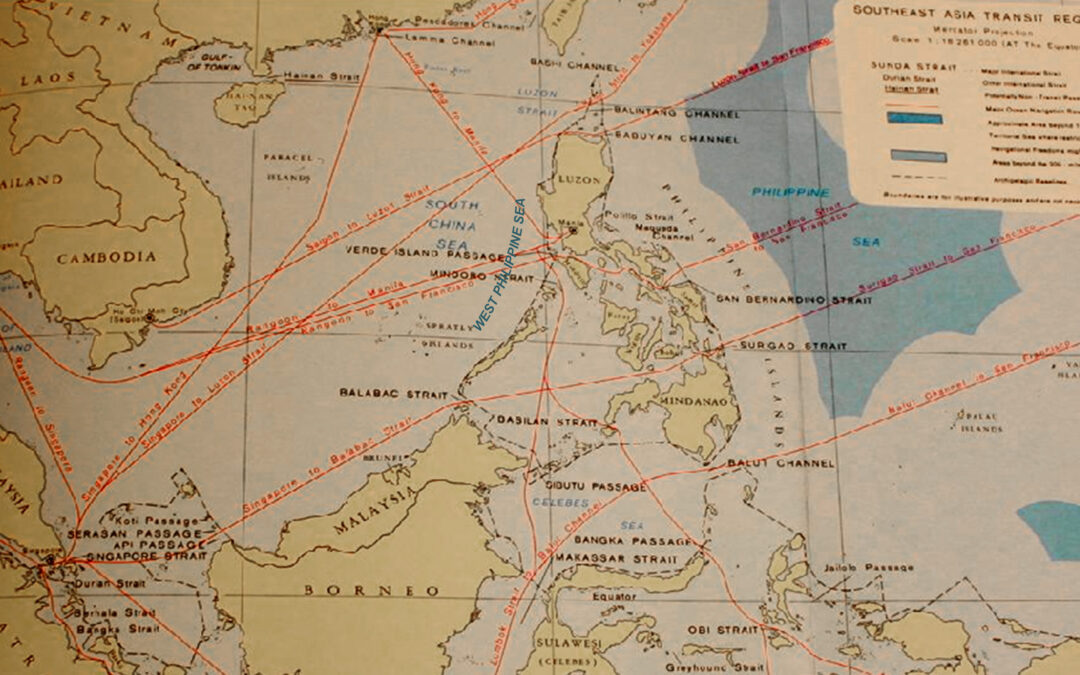
In a previous article, “No Lanes, No Control,” the central argument was clear: a maritime nation that fails to organize, monitor, and regulate the movement of vessels through its own strategic waterways inevitably weakens its sovereignty, maritime safety, and environmental security. For an archipelagic state like the Philippines—located at the crossroads of global maritime trade—the absence of formally recognized and operationalized Archipelagic Sea Lanes (ASL) creates operational blind spots across some of the world’s busiest sea routes.
Today, that warning has become more urgent—and more relevant.
The Philippines now possesses the legal and strategic opportunity to institutionalize and operationalize Philippine ASL consistent with the United Nations Convention on the Law of the Sea (UNCLOS). Article 53 of UNCLOS recognizes the right of archipelagic states to designate sea lanes and air routes suitable for the continuous and expeditious passage of foreign ships and aircraft through or over their archipelagic waters. However, legal authority alone is not enough. Without governance mechanisms, sustainable financing, maritime safety infrastructure, and international recognition through the International Maritime Organization (IMO), ASL risks remaining only a concept on paper rather than a functioning instrument of national maritime governance.
At the center of this challenge lies the fragmented institutional structure currently governing maritime policy implementation. Critical responsibilities are dispersed among the Department of Foreign Affairs (DFA), Department of Transportation (DOTr), National Mapping and Resource Information Authority (NAMRIA), Philippine Coast Guard (PCG), Department of National Defense (DND), Civil Aviation Authority of the Philippines (CAAP), and Department of Environment and Natural Resources (DENR). Each agency plays a vital role, yet without a centralized coordinating mechanism, the country risks duplication, bureaucratic delays, and weak international positioning during IMO deliberations.
This is precisely why the establishment of a National ASL Coordinating Body is strategically indispensable.
Such a mechanism would not merely coordinate paperwork for an IMO submission. More importantly, it would become the nucleus of a long-term maritime governance architecture capable of integrating hydrographic data, navigational safety systems, environmental protection frameworks, maritime domain awareness, and international diplomatic engagement into a unified national strategy.
The strategic importance of operationalizing Philippine ASL is likewise aligned with the policy direction of Ferdinand Marcos Jr. for the Philippines’ 2026 ASEAN Chairmanship, which emphasizes regional resilience, strategic stability, maritime connectivity, energy security, disaster resilience, and practical regional cooperation amid growing geopolitical and economic pressures. A credible and internationally recognized ASL framework would reinforce the Philippines’ role as a responsible maritime and trading nation at the center of Southeast Asian connectivity and Indo-Pacific maritime security.
The operationalization of ASL also creates a transformative opportunity for post-recovery maritime development programs.
Rather than treating maritime safety investments purely as government expenditures, the Philippines can institutionalize a sustainable “user pays” cost-recovery system similar to international maritime best practices. Through the deployment of Vessel Traffic Monitoring Systems (VTMS), Traffic Separation Schemes (TSS), and Aids to Navigation (AtoN) across strategic maritime choke points, the country can establish recurring revenue streams directly linked to maritime safety services. The IMO itself recognizes Traffic Separation Schemes as essential tools for reducing marine casualties and improving navigational safety in congested waters.
These revenues can fundamentally reshape the country’s post-recovery programs in several critical ways.
First, they can finance the modernization and expansion of maritime safety infrastructure without relying solely on annual government appropriations. Strategic VTMS installations in major choke points such as the San Bernardino Strait, Surigao Strait, Balabac Strait, Mindoro Strait, Basilan Strait and Sibutu Passage would significantly improve vessel monitoring, collision prevention, and navigational efficiency for both domestic and international shipping.
Second, these cost-recovery mechanisms can strengthen environmental resilience and disaster response capabilities. Mandatory Tier 2 Oil Spill Response Organization (OSRO) coverage for vessels operating within Philippine waters would create a dedicated funding stream for rapid oil spill response assets, equipment prepositioning, and coastal rehabilitation programs. In an era of increasing maritime traffic and environmental vulnerability, this represents not only an environmental safeguard but also an economic protection mechanism for fisheries, tourism, and coastal communities. The importance of rapid oil spill response has been repeatedly demonstrated following major maritime pollution incidents in Southeast Asia and Philippine waters.
Third, ASL operationalization can become a major catalyst for national economic recovery and maritime investment confidence. International shipping companies prioritize predictability, navigational safety, and internationally compliant maritime governance. IMO-recognized sea lanes supported by modern VTMS infrastructure enhance the Philippines’ reputation as a responsible maritime state capable of protecting global shipping routes while ensuring freedom of navigation and environmental stewardship.
Most importantly, the benefits extend beyond maritime security.
A functioning ASL regime creates jobs in maritime operations, hydrography, marine engineering, environmental management, vessel traffic services, digital communications, and emergency response systems. It stimulates investments in coastal infrastructure, communications networks, and maritime logistics hubs. It also enables the Philippine Coast Guard and partner agencies to transition from reactive maritime enforcement toward proactive maritime governance.
Indonesia’s successful partial ASL recognition in 1998 demonstrated that archipelagic sea lanes are not merely legal declarations—they are instruments of strategic national development. For the Philippines, the institutionalization of ASL represents an opportunity to convert geography into governance advantage.
The way forward is therefore both urgent and strategic.
The issuance of an Executive Order creating a National ASL Coordinating Body should be pursued immediately. Simultaneously, technical studies, hydrographic consolidation, maritime risk assessments, environmental frameworks, and diplomatic engagements for IMO submission must proceed in parallel. Delay only prolongs operational gaps in some of the country’s most strategically sensitive waters.
The Philippines stands at a defining maritime crossroads.
If the country succeeds in institutionalizing and operationalizing its Archipelagic Sea Lanes, it will not only strengthen sovereignty and maritime safety—it will establish a sustainable post-recovery maritime governance model capable of financing long-term national resilience, environmental protection, and economic growth.
Because ultimately, the principle remains unchanged: “Control the Lanes, Protect the Nation.”
References
- United Nations Convention on the Law of the Sea (UNCLOS), Article 53 – Right of Archipelagic Sea Lanes Passage.
- International Maritime Organization (IMO), General Provisions on Ships’ Routeing and Traffic Separation Schemes.
- Philippine Coast Guard Marine Environmental Protection Command reports and regional oil spill response frameworks in Southeast Asia.
- IMO Assembly Resolution on Indonesian Archipelagic Sea Lanes adopted in 1998.