
Co-Author: VADM Joseph M Coyme PCG (Ret), Ph.D.
One of the central arguments advanced during the symposium is that Batanes is a “natural geographic extension” of Taiwan and therefore should belong to China.
This argument is fundamentally flawed.
Anyone can advance imaginative theories that a distant island is merely a “natural geographic extension” of another territory. However, such arguments collapse under both logic and international law.
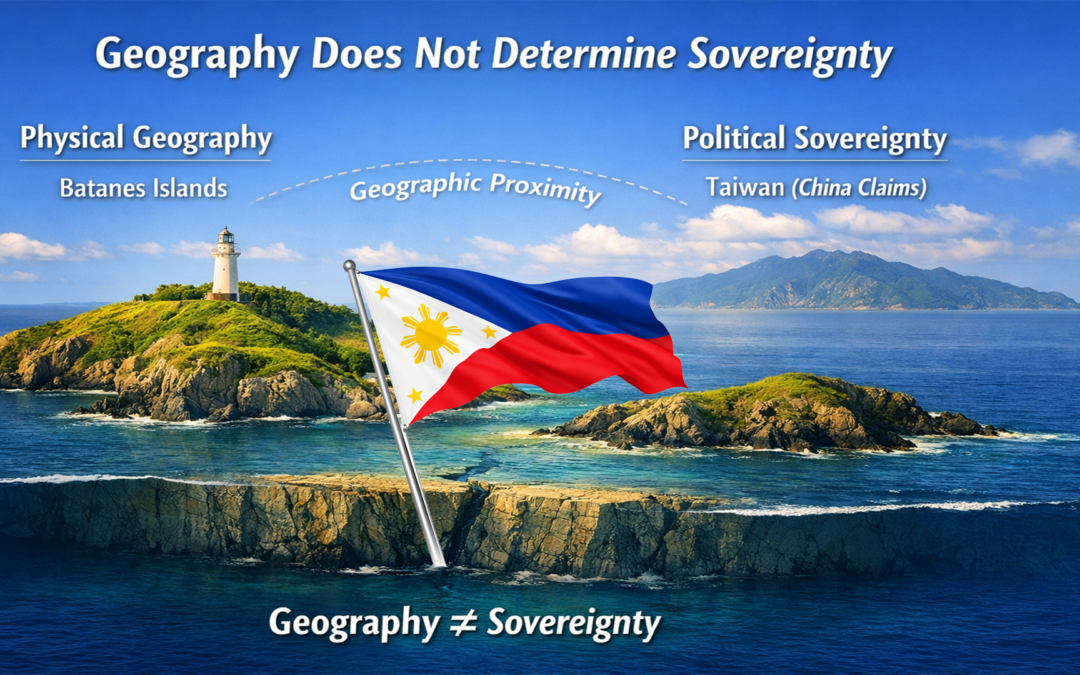
The central flaw lies in conflating physical geography with political sovereignty. These are entirely different concepts. China—or any other State—cannot derive sovereignty simply because an island lies on the same geological shelf or forms part of the same island arc as another territory. International law has consistently rejected such reasoning.
If geographical continuity alone determined sovereignty, the implications would be untenable.
By that reasoning, Hainan Island could be regarded as nothing more than a natural extension of the Asian mainland because it was connected to continental Asia by prehistoric land bridges during periods of lower sea levels. Given its proximity to both China and Vietnam across the Gulf of Tonkin, one could just as plausibly argue that Hainan forms part of Vietnam’s natural geographic extension. Yet no serious geographer, historian, or international lawyer would suggest that geological continuity determines sovereignty over Hainan.
The same reasoning applies to Batanes.
That Batanes may share geological characteristics with Taiwan or belong to the same Luzon-Taiwan island arc does not confer political ownership. Geological formations are products of tectonic forces operating over millions of years, while sovereign boundaries are products of history, treaties, effective administration, constitutional governance, international recognition, and the freely expressed allegiance of peoples. The former belongs to the realm of earth science; the latter belongs to the realm of international law.
If “natural geographic extension” were accepted as a legal basis for territorial acquisition, the stability of the international system would be seriously undermined. Numerous islands around the world are geologically connected to neighboring landmasses while remaining sovereign territories of entirely different States. The British Isles rest upon the European continental shelf yet are not politically part of continental Europe. Madagascar shares geological origins with Africa yet exists as an independent sovereign State. Tasmania lies on the same continental shelf as mainland Australia, but its constitutional status derives from legal and political history rather than geology. Across Southeast Asia, many islands share common geological origins while belonging to different sovereign States.
International law has never recognized geological affinity as evidence of sovereignty. The United Nations Convention on the Law of the Sea (UNCLOS) bases maritime entitlements on sovereignty over land territory—not on geological theories. Likewise, the 2016 South China Sea Arbitral Award reaffirmed that maritime rights must be grounded in lawful title recognized under international law rather than historical narratives, geographical imagination, or expansive interpretations unsupported by contemporary legal principles.
More importantly, Batanes has remained under continuous Philippine administration since its formal incorporation into the Province of Cagayan in 1783. That administration continued uninterrupted through the Spanish colonial government, the First Philippine Republic, the American colonial administration, the Commonwealth, and the Republic of the Philippines. Today, Batanes remains an integral province of the Republic, governed under the Philippine Constitution, represented in Congress, administered by Philippine institutions, and inhabited by Filipino citizens who continuously exercise their rights within the country’s constitutional framework.
The continuing exercise of Philippine sovereignty is demonstrated not only through constitutional and political institutions but also through the provision of essential public services and maritime infrastructure. A notable example occurred in 2022, during the tenure of Admiral Artemio M. Abu, PCG, as Commandant of the Philippine Coast Guard, when the four historic lighthouses of Batanes—Sabtang, Mahatao, Ivana, and Balanga—were ceremonially relighted following their rehabilitation. During the ceremony, Admiral Abu emphasized that these restored aids to navigation would once again serve as vital navigational landmarks for international vessels transiting the Northern Luzon maritime corridor, one of the Philippines’ busiest international shipping routes. Their positions were to be promulgated through Notices to Mariners, incorporated into official nautical publications, and permanently reflected on internationally recognized nautical charts, thereby contributing to the safety of international navigation and fulfilling the Philippines’ obligations under the international maritime regime.
Beyond their operational significance, the restoration of these lighthouses carried profound legal and national importance. The Governor of Batanes and the Ivatan community welcomed the project as a reaffirmation of Batanes’ enduring place within the Philippine archipelago. The rehabilitation and continuous maintenance of these government-owned navigational aids constitute visible manifestations of the Philippine State’s peaceful, continuous, and effective exercise of sovereign authority over the islands. Such governmental functions—maintaining maritime safety infrastructure, issuing navigational information, and supporting international shipping—are classic examples of effectivités, or the actual exercise of State authority, which international jurisprudence has consistently regarded as persuasive evidence of territorial sovereignty.
Philippine sovereignty over Batanes therefore rests upon continuous and effective administration, recognized international boundaries, constitutional governance, and the allegiance of its inhabitants—not upon tectonic plates or ancient land bridges.
Geography may explain how islands were formed; it does not determine who owns them.
To argue that Batanes belongs to Taiwan because it is a “natural geographic extension” is no more persuasive than arguing that Hainan belongs to Vietnam because both occupy the same continental landmass, or that Great Britain should belong to continental Europe because both rest upon the same continental shelf. Such arguments belong to the realm of geology—not international law.
Ultimately, sovereignty is determined not by prehistoric geography but by effective occupation, continuous and peaceful administration, treaties, international recognition, and established principles of international law. Accepting geological extension as a basis for territorial claims would invite limitless revisionist claims worldwide and undermine the stability of the rules-based international order established under the United Nations Charter and UNCLOS.
This distinction is particularly significant today as the Philippines advances the implementation of Republic Act No. 12065 and prepares its IMO-compliant Technical Submission for the designation of Philippine Archipelagic Sea Lanes. The legal status of Batanes is not open to reinterpretation through geological theories or speculative narratives; it rests upon internationally recognized principles of sovereignty, effective governance, and the rule of law.
References
- 1987 Constitution of the Republic of the Philippines, Article I and Article II, Section 2.
- Republic Act No. 9522 (Philippine Archipelagic Baselines Law), 2009.
- Republic Act No. 12065 (Philippine Maritime Zones Act), 2024.
- United Nations Charter (1945), Articles 2 and 33.
- United Nations Convention on the Law of the Sea (UNCLOS), 1982, Part IV (Articles 46–54), particularly Article 53 on Archipelagic Sea Lanes.
- South China Sea Arbitration (Philippines v. China), PCA Case No. 2013-19, Award of 12 July 2016.
- National Historical Commission of the Philippines (NHCP), Statement on the Claim by Some So-Called Chinese Scholars of the Sovereignty of China over the Batanes Islands, July 2026.
- William Dampier, A New Voyage Round the World (1697), documenting his observations of the Batanes Islands and their inhabitants.
- Philippine Coast Guard. “PCG Relights Four Historic Lighthouses in Batanes”(Official News Release, 2022).
- International Court of Justice. Sovereignty over Pulau Ligitan and Pulau Sipadan (Indonesia/Malaysia), Judgment of 17 December 2002 (recognizing the evidentiary value of effectivités, including the construction and maintenance of lighthouses and navigational aids as demonstrations of sovereign authority).
- International Court of Justice. Minquiers and Ecrehos (France/United Kingdom), Judgment of 17 November 1953 (continuous governmental administration as evidence of territorial sovereignty).
- International Association of Marine Aids to Navigation and Lighthouse Authorities (IALA). Recommendation on Marine Aids to Navigation(current edition), recognizing lighthouse authorities as part of a coastal State’s navigational safety responsibilities