
Launching the PASLCI First Founding Anniversary Magazine
In September 2026, as the Philippine Archipelagic Sea Lanes Center, Inc. (PASLCI) celebrates its First Founding Anniversary, the organization will proudly unveil its inaugural commemorative publication—the PASLCI First Founding Anniversary Magazine. More than simply marking a milestone, the magazine represents PASLCI’s vision, accomplishments, and aspirations for the future of Philippine maritime governance.
Its official launch during the anniversary celebration is both timely and symbolic. It signifies the beginning of an enduring publication that will document the country’s maritime transformation, promote informed public discourse, and strengthen awareness of the strategic importance of the Philippine archipelagic sea lanes. It also reflects PASLCI’s commitment to becoming a leading center for maritime research, policy advocacy, education, and strategic collaboration.
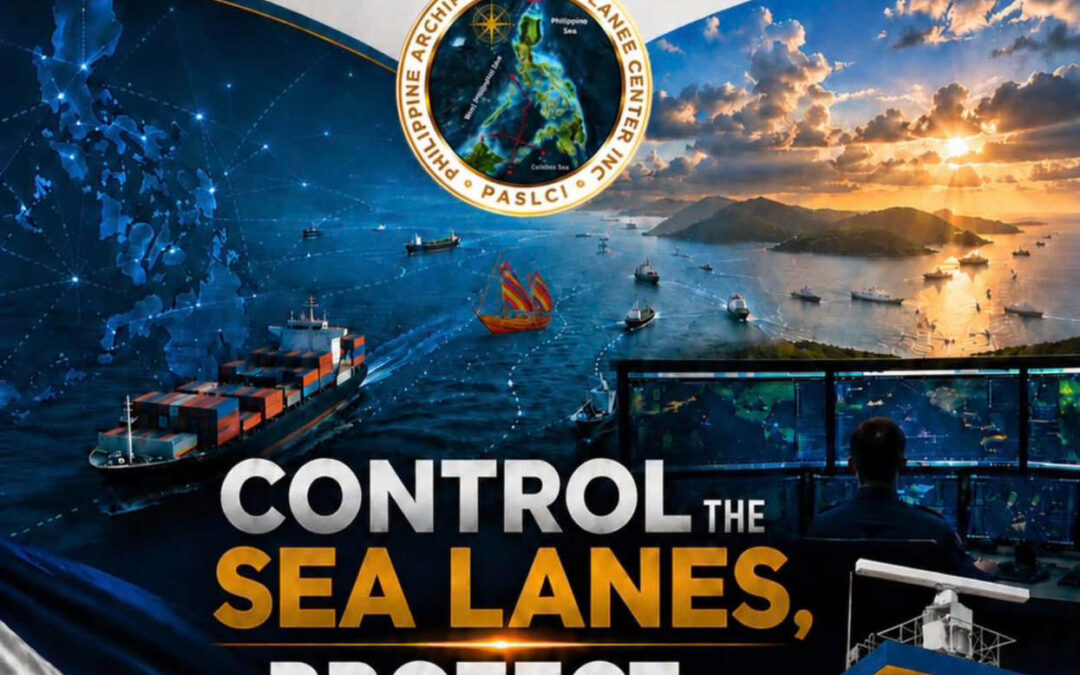
The cover of the magazine serves as a powerful visual narrative. Every element has been deliberately selected to tell the story of a maritime nation whose past, present, and future are inseparably connected by the sea.
At the center of the cover stands the PASLCI seal, representing the organization’s commitment to protecting the Philippines’ strategic archipelagic sea lanes while advancing maritime safety, security, environmental stewardship, and sustainable economic development. Surrounding the seal are images that illustrate the evolution of Philippine maritime governance—from its ancient seafaring traditions to the application of cutting-edge technologies that define the future of maritime domain awareness.
Among these images, none carries greater historical and cultural significance than the Balangay.
The Balangay is far more than an indigenous wooden boat. It is the enduring symbol of the Filipino people’s maritime identity. Archaeological discoveries of the Butuan Balangay boats, recognized as National Cultural Treasures, demonstrate that long before the emergence of modern nation-states, the ancestors of today’s Filipinos were already accomplished shipbuilders, navigators, and traders who maintained vibrant maritime networks throughout Southeast Asia (National Museum of the Philippines, n.d.; Scott, 1994).
Descended from the Austronesian peoples, these early seafarers navigated thousands of nautical miles across the Pacific and Indian Oceans using only the stars, prevailing winds, ocean currents, and an extraordinary understanding of nature. Their remarkable maritime achievements established settlements, expanded trade routes, fostered cultural exchange, and connected islands across Southeast Asia and the Pacific centuries before the advent of modern navigation (UNESCO, 2009; Solheim, 2006).
The Balangay therefore reminds every Filipino that ours has always been a maritime civilization. The sea has never divided our islands; rather, it has united our people, sustained our communities, and shaped our national identity. It is this proud maritime heritage that PASLCI seeks to preserve and celebrate while preparing the country to meet the demands of twenty-first century maritime governance.
Sailing beside the Balangay are modern commercial ships navigating Philippine waters. Their presence symbolizes the continuous evolution of maritime transportation—from ancient wooden vessels to sophisticated international shipping that drives global commerce. Together, these vessels portray a compelling narrative: the Philippines honors its maritime past while embracing technological innovation to secure its maritime future.
This vision is further reflected in the digital maritime map, the Vessel Traffic Management and Monitoring Center, and the Vessel Traffic Service (VTS) facility featured on the cover. These images represent PASLCI’s advocacy for establishing a modern, integrated Vessel Traffic Management System across the Philippine archipelago. Consistent with the standards of the International Maritime Organization (IMO) and the International Association of Marine Aids to Navigation and Lighthouse Authorities (IALA), such a system would significantly improve navigational safety, enhance maritime domain awareness, strengthen environmental protection, optimize port operations, support emergency response, and reinforce national security through real-time monitoring of vessel movements in the country’s most critical waterways (IMO, 2024; IALA, 2021).
For an archipelagic nation composed of more than 7,600 islands and strategically located along some of the world’s busiest international shipping routes, effective management of sea lanes is not merely a transportation concern—it is a strategic national imperative. The legal framework established under the 1982 United Nations Convention on the Law of the Sea (UNCLOS) recognizes the unique rights and responsibilities of archipelagic states in managing their waters while ensuring the safe passage of international navigation. Safe and secure sea lanes protect lives, facilitate commerce, sustain fisheries, promote tourism, preserve marine ecosystems, and safeguard the country’s sovereignty and sovereign rights (UNCLOS, 1982).
The Philippine flag displayed prominently on the cover reminds readers that every maritime initiative ultimately serves the Filipino people. It symbolizes national unity and reinforces the principle that maritime governance contributes directly to national development, economic resilience, and regional stability. This vision is likewise consistent with the strategic directions of the Philippine Coast Guard, the Maritime Industry Authority (MARINA), and the Department of Transportation in strengthening maritime safety, security, and sustainable development.
Equally significant are the icons displayed along the lower portion of the cover. They represent PASLCI’s core pillars of service: Sea Lane Advocacy; Maritime Research and Consulting; Maritime Safety and Policy; Public Education and Training; Strategic Partnerships; International Representation; Stakeholder Development; and Maritime Heritage Promotion. Together, these pillars define PASLCI’s comprehensive approach to building a stronger, safer, and more resilient maritime nation.
The theme, “Control the Sea Lanes, Protect the Nation,” encapsulates this mission. It recognizes that the Philippines’ sea lanes are strategic national assets whose effective governance directly contributes to national security, economic prosperity, environmental sustainability, and the protection of sovereign rights. By promoting integrated maritime governance and encouraging collaboration among government agencies, industry, academia, and international partners, PASLCI aims to help position the Philippines as a respected maritime nation capable of managing one of the world’s most important archipelagic waterways.
The official launch of this magazine during PASLCI’s First Founding Anniversary therefore carries significance beyond the publication itself. It inaugurates what the organization envisions as a lasting platform for sharing knowledge, documenting best practices, highlighting innovations, and fostering meaningful dialogue among maritime professionals, policymakers, scholars, industry leaders, and the Filipino public.
As PASLCI embarks on its second year, this inaugural magazine stands as both a celebration of achievements and a call to action. It invites every Filipino to rediscover the nation’s proud Austronesian seafaring heritage, recognize the strategic importance of its archipelagic sea lanes, and participate in building a maritime future where innovation is guided by history, progress is anchored in national interest, and the sea continues to unite and strengthen the nation.
The cover is therefore more than a commemorative design. It is a declaration of identity. It honors the Balangay that carried the dreams of our ancestors, embraces the technologies that will shape the future of maritime governance, and affirms PASLCI’s enduring commitment to one guiding vision:
Control the Sea Lanes. Protect the Nation. Secure Our Future.
References
International Association of Marine Aids to Navigation and Lighthouse Authorities. (2021). IALA Guideline G1111: Vessel Traffic Services Manual.
International Maritime Organization. (2024). Vessel Traffic Services (VTS). London: IMO.
National Museum of the Philippines. (n.d.). The Butuan Balangay Boats.
Scott, W. H. (1994). Barangay: Sixteenth-Century Philippine Culture and Society. Ateneo de Manila University Press.
Solheim, W. G. II. (2006). Archaeology and Culture in Southeast Asia. University of the Philippines Press.
United Nations. (1982). United Nations Convention on the Law of the Sea (UNCLOS).
UNESCO. (2009). The Balangay Voyages and Austronesian Maritime Heritage.
Nice introductory notes