
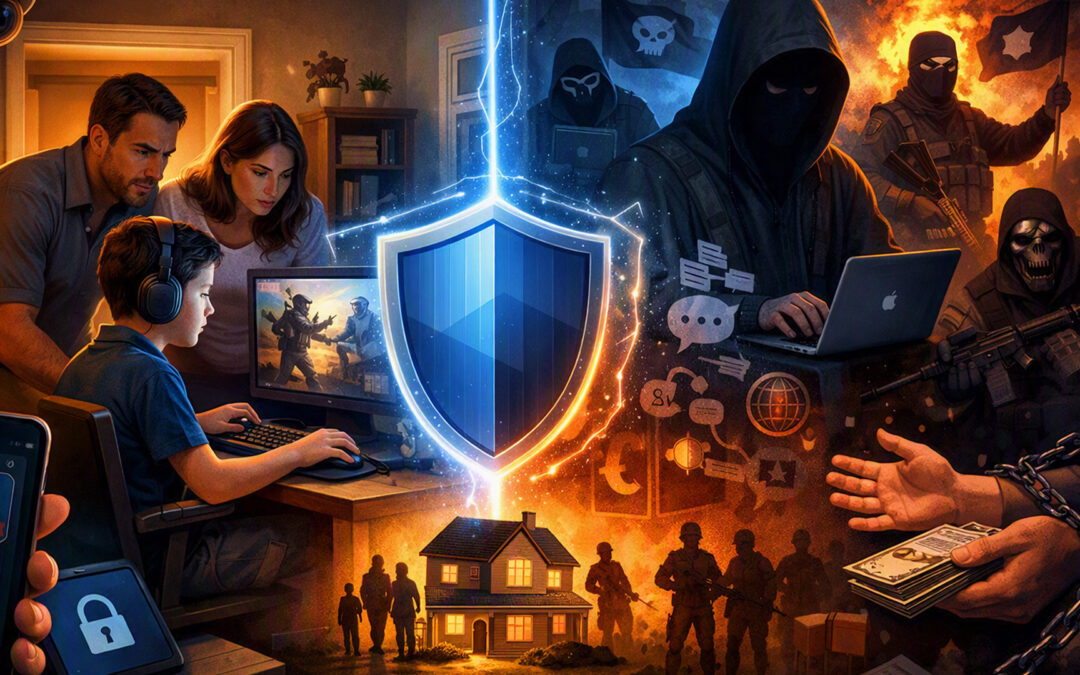
Protecting Our Children from Online Gaming-Related Violence, Exploitation and Radicalization
“Protect the player. Protect the child. Protect the community. Protect the nation.”
I was fortunate to meet Mr. Angel Redoble, a respected cybersecurity expert, during an informal gathering with fellow members of PMA Class of 1994. Our conversation gave me a deeper understanding of an emerging threat that deserves the attention of every parent, educator, community leader and government official: the exploitation of online gaming and digital communities to reach, groom, manipulate and potentially radicalize vulnerable young people.
His insights became particularly relevant following recent tragic incidents involving young people and violence in the Philippines. However, we must be careful not to conclude that online gaming caused any particular tragedy. The circumstances, motives and contributing factors surrounding such incidents must be established through proper investigation.
The more important question is whether online environments can be exploited by individuals or networks seeking to influence vulnerable children.
The evidence tells us that they can.
And this leads to an even more urgent concern.
THE CLEAR AND PRESENT DANGER
Laws, policies, investigations and other institutional measures are necessary—but they take time.
The clear and present danger is already here.
Our children are online today. They are playing games, communicating with strangers, joining communities and forming relationships with people they may never have met in the real world. Some are vulnerable to exploitation, grooming, manipulation, coercion and psychological abuse.
We may never know how many children are currently being groomed or manipulated because much of this activity occurs privately, behind usernames, encrypted communications, closed groups and seemingly ordinary gaming interactions.
The Federal Bureau of Investigation has documented violent online networks that target minors through social media, gaming platforms and mobile applications. These networks may establish trust with vulnerable young people before escalating to threats, blackmail, sexual exploitation, self-harm or violence. (FBI)
The Philippine government has likewise recognized the threat. In March 2026, the Philippine National Police warned that gaming platforms could be exploited to expose young people to violent extremist ideas and directed its Anti-Cybercrime Group to intensify monitoring of gaming communities and chat platforms. (Philippine News Agency)
In July 2026, the Department of Education also reported an initial assessment indicating that some terrorist groomers were using online gaming platforms to reach and recruit young people, including through platforms such as Roblox. (Philippine News Agency)
This is therefore no longer simply an online gaming issue.
It has become a child-protection, public-safety, cybersecurity and national-security concern.
Government must continue developing laws, policies, investigations and regulatory mechanisms. But while those processes are underway, we must act now to protect children and prevent further harm.
The threat is already online. Our response must be equally immediate.
THE DIGITAL BATTLEFIELD
The digital battlefield of the future may not resemble the traditional battlefield.
It may begin with a game.
A young person enters an online gaming community for entertainment, friendship, competition or simply to belong.
An unknown person establishes contact.
Trust develops.
Conversations move from the game to private messaging platforms.
The child may become increasingly isolated from parents, teachers and friends.
Then manipulation begins.
The FBI’s March 2025 public safety alert described how violent online networks, including networks commonly associated with the term “764,” target vulnerable and underage populations through publicly available platforms, including gaming platforms. The FBI reported that perpetrators may first establish trusting relationships before using manipulation, threats, blackmail and coercion. (FBI)
The FBI’s Dallas office issued another warning in May 2026, stating that members of violent online networks commonly referred to as “764” may connect with minors through popular gaming and social-media platforms, pose as friends, and subsequently coerce victims into harmful activities. (FBI)
These warnings should concern every parent.
GAMING IS NOT THE ENEMY
It is important to make this distinction.
Online gaming itself is not the enemy.
Millions of young people play games safely. Gaming can encourage creativity, teamwork, communication, competition and problem-solving.
The danger emerges when gaming intersects with vulnerabilities such as social isolation, excessive use, cyberbullying, predatory behavior, violent communities, self-harm content, grooming or psychological manipulation.
The issue is therefore not:
“How do we stop children from playing games?”
The better question is:
“How do we prevent criminals, predators and violent networks from using gaming environments to reach our children?”
This distinction matters because an effective response must protect children without unfairly treating ordinary gamers or gaming communities as threats.
THE REAL WEAPON: TRUST
The most dangerous tool of an online predator may not be technology.
It may be trust.
Grooming does not necessarily begin with violence.
It may begin with:
“Let’s play.”
“You’re really good.”
“Join our group.”
“You can talk to me.”
“I understand you.”
“You don’t have to tell your parents.”
Gradually, the stranger becomes a trusted friend.
The relationship may then move from an open gaming platform to Discord, Telegram, private messaging or another online community.
The child may begin sharing personal information, secrets, fears, photographs or other private material.
This is where vulnerability can become dangerous.
The FBI has documented cases in which violent online networks use relationships of trust to manipulate and coerce minors into producing sexual or violent material, engaging in self-harm or other harmful acts, and then use threats or blackmail to maintain control. (FBI)
The lesson is therefore not:
“Online games cause violence.”
The lesson is:
“Online platforms can be exploited by people who seek to manipulate vulnerable children.”
THE RECENT TRAGEDIES: A CALL FOR REFLECTION
Recent incidents of violence involving young people should make all of us reflect.
When violence occurs, we naturally ask:
Was it the parents?
The school?
Social media?
Gaming?
Mental health?
Bullying?
Access to weapons?
Government?
These are legitimate questions.
But perhaps the more important question is:
What did we fail to see before it was too late?
We must investigate without speculation and without prematurely blaming any single person, platform or institution.
Investigators should examine the complete environment surrounding a young person—including family circumstances, school experiences, mental health, social relationships, online activity, gaming, bullying, access to weapons and other possible contributing factors.
We must seek facts, not assumptions.
At the same time, uncertainty about the cause of an individual tragedy must not become an excuse for ignoring a documented threat.
The existence of online grooming, exploitation and violent networks is already established by law-enforcement investigations in several countries. Philippine authorities have also publicly acknowledged concerns involving gaming platforms, child exploitation and extremist recruitment. (Philippine News Agency)
WATCH THE CHILD, NOT JUST THE SCREEN
Parents should watch for significant behavioral changes:
- sudden secrecy about devices;
- withdrawal from family;
- unusual anxiety or fear;
- major changes in sleeping habits;
- declining school performance;
- loss of interest in previous activities;
- unusual aggression;
- excessive or compulsive gaming;
- emotional dependence on an online friend;
- sudden involvement in unknown online groups;
- unexplained gifts or gaming currency;
- disturbing fascination with violence; or
- expressions of hopelessness or self-harm.
These signs do not prove grooming or radicalization.
But they deserve attention.
The FBI has identified behavioral changes, isolation, unusual online relationships, fear and unexplained gifts or gaming currency among potential warning signs associated with online exploitation. (FBI)
Sometimes, recognizing a change early can make the difference.
CONNECTION BEFORE CONFRONTATION
When parents discover disturbing online activity, the instinct may be to confiscate the phone or immediately delete the game.
The intention is protection.
But punishment without understanding may cause a child to hide the problem.
Instead, begin with:
“What happened?”
“Who were you talking to?”
“Did someone threaten you?”
“Did someone ask you to keep something secret?”
And most importantly:
“Whatever happened, you can tell me. You are not in trouble. I am here to help you.”
The first intervention may not be a police operation or government program.
It may be a conversation at the dinner table.
PARENTS ARE THE FIRST LINE OF DEFENSE
Parents do not have to become cybersecurity experts.
But they must become digitally present.
Know the games.
Know the platforms.
Understand their communication features.
Know the online communities your children participate in.
Understand privacy settings, reporting mechanisms and parental controls.
And most importantly:
Know your child.
The PNP and DepEd have both emphasized the importance of parental awareness and supervision as part of protecting children from emerging online threats. (Philippine News Agency)
The child does not need adults fighting over who is responsible.
The child needs adults working together.
A WHOLE-OF-SOCIETY RESPONSE
Protecting children from digital exploitation requires cooperation among:
Families — supervision, communication and early detection.
Schools — guidance, counseling, digital literacy and referral.
Mental-health professionals — assessment, intervention and recovery.
Law enforcement — investigation, victim protection and prosecution.
Cybersecurity and intelligence agencies — threat detection, attribution and disruption of violent networks.
Technology and gaming companies — age-appropriate safeguards, moderation, rapid response and effective reporting mechanisms.
Government — policy, regulation, coordination and resources.
Civil society and academia — research, education and community resilience.
This must be approached as a whole-of-government and whole-of-society effort.
Because this is no longer simply about gaming.
It is about protecting children.
It is about public safety.
It is about cybersecurity.
And where violent extremist or nihilistic networks seek to exploit vulnerable young people, it becomes a matter of national security.
GOVERNMENT MUST ACT—BUT WE CANNOT WAIT
Government must act.
Schools must act.
Technology companies must act.
Law enforcement must act.
Parents must act.
But none of us should wait for another tragedy, another investigation or another law before taking reasonable protective measures.
Our children are already online.
Some are gaming.
Some are talking to strangers.
Some are being bullied.
Some are lonely.
Some are being groomed.
Some may already be receiving messages that no child should ever receive.
The challenge is that we cannot know how many.
That uncertainty is precisely why vigilance matters.
We cannot monitor every screen or eliminate every online threat.
But we can make sure our children know that there is always a safe place to return to.
We can teach them that not everyone online is their friend.
We can teach them that secrecy, threats and blackmail are warning signs.
We can teach them that disturbing requests should be reported.
We can teach them that asking for help is not weakness.
And we can tell them:
“You can always come home and talk to me.”
THE RESPONSE MUST BE IMMEDIATE
Laws and policies remain essential.
Investigations remain essential.
Regulation remains essential.
Technology and law-enforcement capabilities must continue to improve.
But while institutions deliberate and processes take their course, children remain online.
That is why prevention cannot wait.
The first response may be a parent asking a question.
The second may be a teacher noticing a behavioral change.
The third may be a school counselor intervening.
Another may be a platform identifying suspicious behavior.
Another may be law enforcement disrupting a predator or violent network.
Each intervention matters.
Because we may never know which intervention prevented the next victim.
The threat is already online.
Our response must be equally immediate.
OUR RESPONSIBILITY BEGINS AT HOME
The digital battlefield may be everywhere.
But the first line of defense remains where it has always been:
AT HOME.
Protect the player.
Protect the child.
Protect the community.
Protect the nation.
Selected References
- Federal Bureau of Investigation, “Violent Online Networks Target Vulnerable and Underage Populations Across the United States and Around the Globe,”March 6, 2025. (FBI)
- FBI Dallas, “Open Letter to Parents, Guardians, and Teachers,” May 12, 2026. (FBI)
- Federal Bureau of Investigation, “FBI Boston Warns of Nihilistic Violent Extremists Targeting Children and Vulnerable Victims Online,” February 19, 2026. (FBI)
- Philippine News Agency, “PNP flags violence indoctrination risk in online games,” March 16, 2026. (Philippine News Agency)
- Philippine News Agency, “PNP heightens drive vs. criminal activities using online gaming apps,” March 22, 2026. (Philippine News Agency)
- Philippine News Agency, “DepEd collabs with PNP, DICT vs. online terrorist groomers,” July 2, 2026. (Philippine News Agency)
- Philippine News Agency, “Senate probe sought on Roblox, online gaming platforms,” March 23, 2026. (Philippine News Agency)
- World Health Organization, Health Behaviour in School-aged Children (HBSC) Study, 2024.
- Republic Act No. 12080, Basic Education Mental Health and Well-Being Promotion Act.