
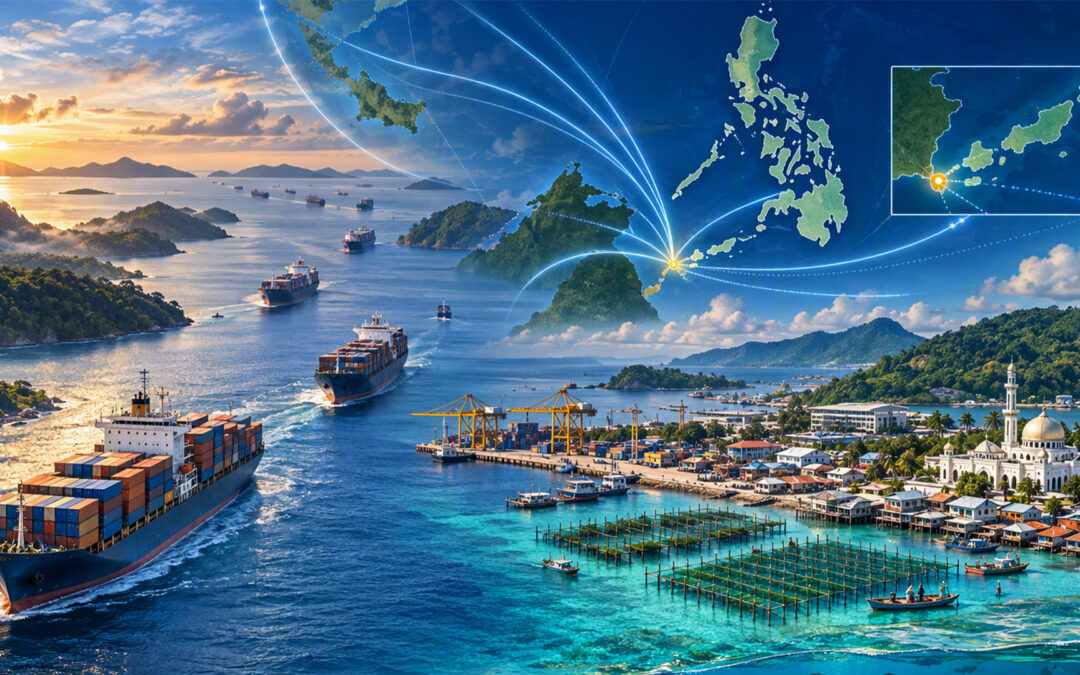
The Philippines stands at a strategic maritime crossroads in Southeast Asia. One of its most significant yet underdeveloped maritime economic gateways is the Sibutu Passage in Tawi-Tawi, a vital route connecting the Celebes Sea and the Sulu Sea and forming part of the country’s legally established archipelagic sea-lane system.
On 6 October 2026, the Philippine Archipelagic Sea Lanes Center, Inc. (PASLCI) had the opportunity to present to PEZA Director General Teodoro “Teo” Panga a development concept for a Maritime Economic and Logistics Hub in Tawi-Tawi, with the Sibutu Passage as its maritime gateway.
The concept is simple but transformative: build an economic ecosystem around an existing international maritime route and enable Tawi-Tawi to capture greater economic value from the maritime traffic passing through its waters.
From Sea Lane to Economic Gateway
Republic Act No. 12065, or the Philippine Archipelagic Sea Lanes Act, identifies the route Celebes Sea–Sibutu Passage–Sulu Sea–Cuyo East Pass–Mindoro Strait–West Philippine Sea as one of the country’s three archipelagic sea lanes. The law places archipelagic sea lanes within a broader framework of navigation safety, environmental protection, sustainable maritime use and national security.
This strategic location creates an opportunity to develop more than a conventional port.
The proposed hub could integrate maritime logistics, ship services, vessel support, warehousing, cargo handling, fisheries and aquaculture processing, cold-chain facilities, trade, tourism, halal industries, ship repair and other investment activities within a potential PEZA economic zone.
It could also establish stronger economic connections between Tawi-Tawi, the domestic Philippine market, BIMP-EAGA, Sabah, Singapore and the wider Indo-Pacific.
The opportunity is consistent with the direction of BIMP-EAGA. In 2026, BIMP-EAGA identified the Tawi-Tawi Special Ecozone as a potential transshipment hub, while Bongao is increasingly being positioned as a center for tourism, trade and halal-market development.
A separate September 2026 BIMP-EAGA report noted that Mindanao and BARMM are seeking to expand economic zones to attract investment, create jobs and stimulate sustainable development. It specifically identified a maritime and tourism zone and a modern freeport and logistics hub in Tawi-Tawi as proposed initiatives that could position the province as a gateway to BIMP-EAGA.
Beyond Economics: Peace, Security and Human Dignity
The significance of this project, however, extends far beyond trade and investment.
For Tawi-Tawi, economic development and security are inseparable.
A maritime economic hub can create direct and indirect employment in port operations, logistics, ship services, construction, fisheries, aquaculture, processing, transportation, warehousing, tourism, maritime services and other supporting industries.
The World Bank’s 2026 assessment of maritime transport in East Asia and the Pacific underscores the potential of the maritime sector to generate employment and support livelihoods through its broader economic multiplier effects.
For Tawi-Tawi and the wider Bangsamoro region, legitimate employment close to home can have an even greater significance.
It can help address a difficult cycle:
Limited local employment → migration pressure → irregular migration → vulnerability to illegal recruitment and trafficking → exploitation → economic and social insecurity.
This is not an argument against legitimate migration. Migration undertaken through lawful channels can be an important source of opportunity and income. The concern is irregular migration driven by economic necessity and exploited by traffickers and illegal recruiters.
Recent government operations demonstrate that this remains a serious concern.
In August 2025, authorities rescued 22 would-be trafficking victims in Tawi-Tawi who were allegedly preparing to travel to Sabah through a “backdoor” route after being promised employment in Malaysia.
In September 2025, the National Bureau of Investigation reported the rescue of 27 trafficking victims in Tawi-Tawi and the arrest of three alleged facilitators. Investigators found that victims had been recruited for supposed overseas employment and were instructed to travel irregularly through Manila, Zamboanga, Tawi-Tawi and Malaysia before reaching Cambodia.
The problem has continued into 2026. The Bureau of Immigration reported a case involving a Filipina who departed through Tawi-Tawi and subsequently passed through Sabah and other countries before reaching Cambodia, where she was forced into exploitative work. The agency warned that unauthorized departures can increase vulnerability to trafficking and exploitation.
These incidents demonstrate why economic development should be viewed as part of a broader peace and security strategy.
A person with access to decent work, livelihood, skills development and economic opportunity at home has more choices. A community with legitimate businesses, functioning ports, reliable transportation and investment opportunities has a stronger economic foundation.
At the same time, a province with growing legitimate maritime activity can develop stronger institutional capacity and incentives to protect its waters, regulate maritime movements and cooperate with national security and law-enforcement agencies.
Economic Development as a Security Multiplier
The proposed hub should therefore be designed not simply as an investment zone, but as a secure, inclusive and sustainable maritime economic ecosystem.
Economic activity can be accompanied by stronger maritime governance through:
- improved port and maritime infrastructure;
- greater presence of legitimate commercial vessels and maritime services;
- stronger vessel monitoring and maritime domain awareness;
- better coordination among the PCG, PNP Maritime Group, BFAR, Bureau of Customs, Bureau of Immigration and other concerned agencies;
- improved regulation of private wharves and maritime access points;
- stronger protection against smuggling, trafficking and other illicit maritime activities; and
- better opportunities for local maritime employment and skills development.
This is where the Philippine Archipelagic Sea Lanes concept becomes especially important:
VTMS sees.
AtoN guides.
TSS organizes.
MDA connects.
ASL integrates.
The same maritime infrastructure that facilitates safe and efficient navigation can also contribute to better maritime governance and a more secure operating environment for legitimate commerce.
Security, therefore, should not be viewed merely as an enforcement function.
Security is also an enabling condition for investment, employment and sustainable development.
A Gateway to Shared Prosperity
The proposed Maritime Economic and Logistics Hub could create opportunities not only for Tawi-Tawi but also for Sulu, Basilan and the wider Bangsamoro region.
Its economic ecosystem could support:
Maritime logistics → port services → ship support → fisheries and aquaculture → processing → warehousing → transportation → tourism → manufacturing → trade and exports.
Each activity can generate employment, entrepreneurship, skills development and local supply chains.
This is consistent with the broader direction of BIMP-EAGA. The leaders of Brunei Darussalam, Indonesia, Malaysia and the Philippines adopted BIMP-EAGA Vision 2035 in May 2026, advancing a vision of a socially inclusive, open, aligned and resilient subregion pursuing shared economic prosperity and sustainability.
Tawi-Tawi is uniquely positioned to contribute to that vision.
Its geography, however, should not merely make it a place through which ships pass.
Its geography can become an economic asset.
From Passage to Gateway
The ultimate vision is therefore bigger than a port.
It is bigger than an economic zone.
It is even bigger than a logistics hub.
It is about creating a maritime economic ecosystem that connects prosperity with peace, security with opportunity, and development with human dignity.
The transformation can be expressed simply:
From maritime passage → to maritime gateway → to economic hub → to jobs and livelihoods → to stronger communities → to greater peace, security and prosperity.
The project cannot, by itself, solve all the socioeconomic and security challenges of Tawi-Tawi, Sulu, Basilan or the wider Bangsamoro region. Nor can economic development substitute for effective law enforcement, border management, social protection and good governance.
But it can provide something equally important:
a legitimate economic alternative.
An alternative to economic desperation.
An alternative to unsafe migration.
An alternative to illegal recruitment and trafficking.
An alternative to an economy where people are forced to look elsewhere simply because opportunities at home are limited.
The dream is to make Tawi-Tawi a place where people do not have to leave home to find a better future—because the future can be built at home.
And when that future is built around a strategic maritime gateway, the benefits can extend beyond one province.
They can contribute to a more connected, secure, peaceful and prosperous Bangsamoro, Philippines and BIMP-EAGA region.
From Sibutu Passage to Maritime Prosperity.
From maritime connectivity to shared prosperity.
From economic opportunity to peace and security.
Kaya natin ito.
References;
- Republic Act No. 12065 – Philippine Archipelagic Sea Lanes Act. Legal foundation for the Philippine ASL system and the designation of the Celebes Sea–Sibutu Passage–Sulu Sea–Cuyo East Pass–Mindoro Strait–West Philippine Sea route.
- BIMP-EAGA, “Bangsamoro Region Deepens Trade Links with BIMP-EAGA,” September 2026. Supports the discussion of Tawi-Tawi as a potential transshipment hub and gateway to BIMP-EAGA.
- BIMP-EAGA, “Mindanao Wants to Be More Strategic in Developing Economic Zones,” September 2026. Supports the relationship between economic zones, investment, employment and sustainable development.
- BIMP-EAGA Special Summit 2026 Joint Statement / BIMP-EAGA Vision 2035. Supports the broader framework of inclusive growth, resilience, connectivity, sustainability and shared prosperity.
- World Bank, “Maritime Transport Can Drive Jobs and Economic Growth in East Asia and the Pacific,” 27 July 2026. Supports the role of maritime transport in employment generation and economic development.
- National Bureau of Investigation, September 2025. Official documentation of a Tawi-Tawi trafficking operation involving 27 victims and alleged facilitators.
- Bureau of Immigration, 2026. Government warning concerning unauthorized “backdoor” departures and their relationship to trafficking and exploitation.
- Philippine News Agency, August 2025. Report on the rescue of 22 would-be trafficking victims in Tawi-Tawi who were allegedly preparing to travel to Sabah through an unauthorized route.