
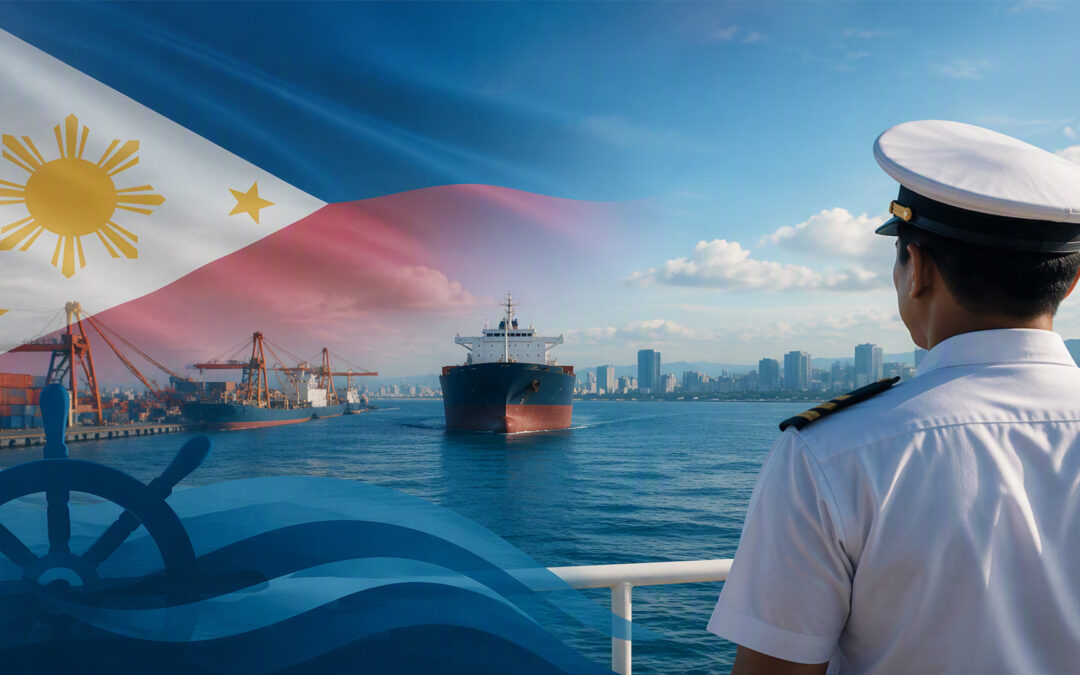
Completing an Unfinished Maritime Reform: Toward a Department of Maritime and Ocean Affairs for an Archipelagic Nation
The Philippines is an archipelagic State, but its governmental institutions have never fully reflected the maritime character of the nation.
For centuries before colonial rule, the sea connected rather than separated the peoples of the Philippine archipelago. Our ancestors were boat builders, navigators, traders and voyagers. The sea was their highway and the islands were nodes in a much larger maritime world.
Colonial rule and the subsequent development of a predominantly land-centered administrative system gradually weakened this maritime orientation. The Philippines remained geographically maritime, but the sea receded from the center of national consciousness and governance. What emerged might be described as a form of “maritime amnesia”: the maritime inheritance remained, but its place in the Filipino understanding of nationhood became obscured.
The metaphorical “seafaring DNA” of an archipelagic people, however, did not disappear. It lay dormant. History suggests that such consciousness can awaken again.
This paper argues that such an awakening must now be translated from maritime memory into maritime policy, and from maritime policy into maritime institutions.
An unfinished reform
The institutional roots of this argument reach back almost three decades.
On 21 October 1997, the Presidential Multi-Sectoral Task Force on Maritime Development submitted to President Fidel V. Ramos its Report of the Multi-Sectoral Task Force on Maritime Development on the Implementation of Measures to Launch the Philippines as a Maritime Power in the 21st Century.
The accompanying memorandum described the report as the product of collaboration between government and private-sector maritime stakeholders and recorded that leaders of the maritime industry strongly recommended it as the “Bible” of the national maritime development program.
Significantly, the report identified the fragmented system of Philippine Maritime Administration (MARAD) as a major impediment to maritime development.
Its first institutional recommendations called for stronger unified maritime leadership and proposed consolidation of the maritime agencies then under the Department of Transportation and Communications—including MARINA, PPA, PMMA and, eventually, the Philippine Coast 2
Guard—into a maritime directorate intended to bring greater coherence to a restructuring Philippine MARAD.
The ultimate direction of this reform effort was the establishment of a Department of Maritime Affairs.
The following year, an important component of that program was implemented.
Executive Order No. 475 of March 30, 1998 transferred the Philippine Coast Guard from the Philippine Navy and Department of National Defense to the Office of the President. Crucially, EO 475 expressly stated that the PCG mandate and the government’s program to “rationalize Philippine Maritime administration” could be better pursued under the new arrangement. EO 477 of April 15, 1998 subsequently transferred the PCG to DOTC, again expressly connecting the action with rationalization of maritime administration and improved policy and program coordination.
The transfer was therefore not conceived as an isolated administrative relocation of the Coast Guard. It formed part of a larger reform trajectory already articulated in 1997.
The expiration of the Ramos administration prevented that institutional progression from being completed.
The reform remained unfinished.
A problem that survived for three decades
Subsequent developments demonstrate that the structural problem identified in 1997 did not disappear.
In 2011, congressional discussion of Senator Rodolfo Biazon’s proposed Maritime Administration Act again described maritime functions as distributed among 14 bureaus and agencies under seven (7) departments, producing fragmentation, functional overlap and conflicting regulations. Biazon proposed a Philippine Maritime Commission as the central maritime-administration institution.
Senator Antonio Trillanes IV subsequently introduced Department of Maritime Affairs legislation across four successive Congresses—the 14th, 15th, 16th and 17th—providing further evidence of continuing legislative concern over the absence of a unified maritime institutional structure.
Congress itself demonstrated the feasibility of rationalization through Republic Act No. 10635, which designated MARINA as the single maritime administration for implementation and enforcement of the STCW Convention and consolidated relevant responsibilities previously distributed among several agencies.
Executive action likewise moved progressively toward greater coordination. 3
Executive Order No. 57 of 2011 established the National Coast Watch System as the central inter-agency mechanism for a “coordinated and coherent approach” to maritime issues.
Executive Order No. 57 of 2024 subsequently reorganized that structure into the National Maritime Council, supported by the Presidential Office for Maritime Concerns and National Maritime Center. Significantly, the Order recognizes maritime security as encompassing military, socioeconomic, environmental and political concerns and directs government to harmonize agency roles, capabilities and funding.
These developments demonstrate institutional progress.
But they also reveal the persistence of the underlying problem.
For almost three decades, the Philippines has responded to fragmented maritime administration principally by improving coordination among the fragments.
The question this paper raises is whether the country is now ready for the next stage:
FRAGMENTATION → COORDINATION → RATIONALIZATION → INTEGRATION
The PCG question is larger than DOTr versus DILG
The issue has acquired immediate relevance because of the September 2026 proposal to transfer the Philippine Coast Guard from DOTr to DILG. Interior Secretary Jonvic Remulla has argued that placing the PCG under DILG could streamline maritime law enforcement and eliminate duplication with the PNP Maritime Group.
That rationale deserves consideration.
But it addresses only part of the PCG’s institutional character.
Republic Act No. 9993 establishes the PCG as an armed and uniformed service attached to the transportation department, but its statutory functions extend far beyond policing. They include maritime safety, vessel inspection, port-state control, search and rescue, aids to navigation, marine environmental protection, maritime law enforcement and maritime security.
The increasing prominence of the West Philippine Sea has understandably brought the PCG’s security role to the forefront of public attention.
But the institutional future of the Philippine Coast Guard should not be determined by the crisis of the moment.
The appropriate question is not simply whether an armed and uniformed PCG administratively resembles institutions under DILG.
The more fundamental question is: 4
Where should a civilian, armed, uniformed and multi-mission Coast Guard belong within the comprehensive maritime administration of an archipelagic State?
Moving the PCG from one sectoral department to another may change its administrative location without resolving the fragmentation of MARAD.
This paper therefore proposes that the present controversy be used to examine the larger institutional question first identified in 1997.
From maritime amnesia to maritime awakening
Institutional reform, however, is only half of this story.
The other half concerns national consciousness.
The author’s own journey illustrates that connection.
Known primarily as a mountaineer and leader of the successful Philippine Mount Everest Expedition, he nevertheless describes within himself a persistent maritime soul—an inheritance of an archipelagic people that remained beneath the country’s wider maritime amnesia.
The Voyage of the Balangay became an instrument for awakening that consciousness.
The Balangay was never merely an ancient boat reconstructed for adventure. Its modern voyages were intended to remind Filipinos that their ancestors possessed the knowledge, courage and maritime technology to navigate across seas long before colonial rule.
The Balangay thus became both memory and metaphor.
And sometimes one voyage inspires another.
University of the Philippines marine scientist Prof. Deo Florence Onda later undertook an audacious journey in the opposite direction from Everest: descending into the Philippine Trench. His achievement points toward another dimension of maritime awakening—not only remembering the voyages of the past, but exploring, studying and protecting the enormous ocean realm upon which the Philippines depends.
The symbolism connects three seemingly different endeavors:
Everest — upward, demonstrating what Filipinos can accomplish.
Balangay — outward, rediscovering the maritime inheritance of our ancestors.
The Philippine Trench — downward, exploring the largely unknown ocean world beneath us. 5
Together they express the Kaya ng Pinoy spirit and a reawakening from maritime amnesia.
Everest demonstrated what Filipinos could accomplish.
Balangay reminded Filipinos who they had been.
Ocean exploration reveals how much remains to be discovered.
Maritime governance asks what the Philippines must now become.
Geography must finally shape governance
The maritime argument is ultimately grounded in geography.
The Philippines consists of more than 7,600 islands situated within an immense maritime domain. Republic Act No. 12064 now expressly defines the country’s maritime zones—including internal waters, archipelagic waters, territorial sea, contiguous zone, exclusive economic zone and continental shelf—in accordance with the Constitution and UNCLOS.
The central point is not merely that the Philippines possess large areas of water.
It is that the national space, economy, security, environment, food system, transportation network and international relationships are inseparable from the sea.
A methodological caution should accompany the memorable “88 percent water, 12 percent land” formulation used in maritime discussions. Published Philippine sources also use an 88:12 ratio to distinguish oceanic from coastal portions of approximately 2.2 million square kilometers of marine waters; the precise percentage therefore depends on what geographic categories are being compared. The final paper should attribute Prof. Onda’s formulation to his lecture unless we locate the exact dataset underlying it, rather than present the ratio as an uncontested land-to-water measurement.
The larger proposition remains compelling:
The institutional architecture of the Philippine State does not adequately reflect the overwhelmingly maritime character of Philippine geography.
This is a mismatch between the geography of the nation and the architecture of the State.
Toward a Department of Maritime and Ocean Affairs
This paper therefore proposes serious consideration of a Department of Maritime and Ocean Affairs (DMOA) as the eventual principal civilian institution for integrated Philippine maritime governance. 6
The term Ocean Affairs recognizes that twenty-first-century maritime policy extends far beyond shipping. It encompasses maritime safety and security, ports and logistics, marine environmental protection, fisheries, maritime-domain awareness, ocean science, seafarers, shipbuilding, marine resources, blue-economy development, climate resilience, marine spatial planning, maritime heritage and international maritime obligations.
A DMOA should not simply absorb every government institution that touches the sea.
Instead, this paper proposes a four-part institutional test:
TRANSFER functions fundamentally maritime in character and better administered within one department.
ATTACH specialized maritime agencies requiring operational or regulatory autonomy.
COORDINATE agencies whose broader mandates must remain elsewhere but whose maritime functions require permanent integration.
RETAIN defense, diplomacy and other specialized functions where institutional independence remains essential.
The guiding principle should be:
Consolidate where unity improves performance; coordinate where specialization must remain.
The existing National Maritime Council should likewise should continue. A future DMOA and the NMC could perform complementary functions: the Department providing permanent administrative and policy capacity, while the Council provides strategic whole-of-government coordination involving defense, diplomacy, security and other Cabinet portfolios.
Recent developments reinforce the need for such coherence. MARINA’s 2025–2026 work on the Philippine Maritime Strategy and IMO implementation continues to bring together DOTr, DFA, PCG, PPA, port authorities, NTC, NAMRIA, PAGASA, BFAR, DENR and other institutions to fulfill responsibilities that international law assigns to the Philippines as one State. The IMO itself requires Member States to maintain adequate and effective systems for discharging their responsibilities as flag, port and coastal States.
Completing the journey
This paper therefore does not propose an entirely new idea.
It proposes completing and modernizing an unfinished one.
In 1997, the national objective was audaciously expressed as launching the Philippines as a maritime power in the twenty-first century. 7
In 1998, the PCG transfer became one tangible institutional step toward rationalizing MARAD.
Later governments and legislators continued searching for mechanisms to overcome fragmentation.
Nearly three decades into the twenty-first century, the fundamental question remains:
How should an archipelagic nation govern its maritime domain?
The answer cannot be found simply by transferring the Coast Guard from one department to another.
It requires reconnecting geography, history, consciousness, policy and institutions.
The intellectual journey of the paper can therefore be expressed through two parallel progressions:
Maritime Civilization → Maritime Amnesia → Maritime Awakening → Maritime Consciousness → Maritime Governance
and
Fragmentation → Coordination → Rationalization → Integration
These two journeys ultimately converge.
The first restores the sea to the consciousness of the Filipino.
The second restores the sea to the architecture of the Philippine State.
The Balangay returned the sea to the consciousness of the Filipino.
The unfinished task is to return the sea to the center of Philippine governance.
ARTURO “ART” VALDEZ Former DOTC Undersecretary for Maritime Affairs Former Head, MTFMD Secretariat/Technical Working Group 8
Expedition Leader, First Philippine Mount Everest Expedition & Voyage of the Balangay Founding Member, Philippine Archipelagic Sea Lanes Center, Inc. (PASLCI)
About the Author
Arturo “Art” Valdez served as Undersecretary for Maritime Affairs of the Department of Transportation and Communications (DOTC) during the Ramos administration and headed the Secretariat of the Multi-Sectoral Task Force on Maritime Development (MTFMD), which served as the Task Force’s Technical Working Group.
In that capacity, he was directly involved in the formulation of the 1997 national maritime development report, which identified the fragmented system of Philippine Maritime Administration (MARAD) as a major impediment to the country’s maritime development and proposed the consolidation and rationalization of maritime institutions. He subsequently played a leading role in the 1998 transfer of the Philippine Coast Guard from the defense establishment to civilian authority, an important step in the broader effort to rationalize Philippine maritime administration.
Beyond government service, Valdez became widely known as Expedition Leader of the First Philippine Mount Everest Expedition and later led the Voyage of the Balangay, an undertaking intended to rekindle Filipino awareness of the country’s ancient maritime heritage and seafaring tradition. He is also a founding figure of the Philippine Archipelagic Sea Lanes Center, Inc. (PASLCI).
Nearly three decades after the 1997 initiative, MARAD Development Since 1997 reflects his continuing advocacy for a Philippine maritime-governance structure commensurate with the country’s character as an archipelagic and maritime nation.
A timely and compelling paper that brings to the fore a fundamental reality: the Philippines is an archipelagic nation, yet our governance structures have yet to fully reflect our identity as a maritime and ocean nation. The call to complete the unfinished maritime reform is both strategic and necessary—not simply to reorganize institutions, but to establish a coherent national framework that connects maritime governance, ocean affairs, safety, security, environmental protection, blue economy, and national development. This paper challenges us to look beyond fragmented mandates and embrace a whole-of-nation, whole-of-ocean approach where the sea is not a boundary between our islands, but the space that connects our people, economy, sovereignty, and future.