
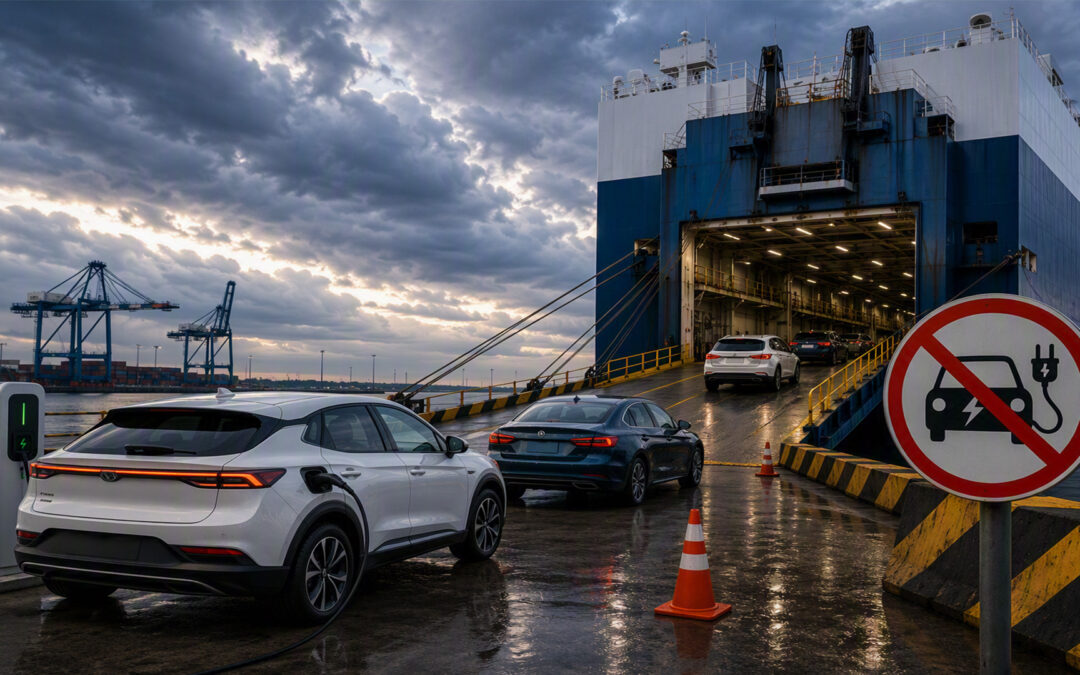
The Case of the MV June Aster Fire Incident
The tragic fire aboard MV June Aster on September 9, 2026, has reignited public debate about the safety of electric vehicles (EVs) and hybrid electric vehicles (HEVs), particularly when transported aboard passenger and cargo roll-on/roll-off (ro-ro) vessels. The disaster claimed seventy-seven lives, left many families grieving, and raised difficult questions that investigators are still working to answer.
Beyond the headlines and technical discussions lies a painful reality. Families lost loved ones, survivors endured a terrifying ordeal at sea, and an entire maritime community was reminded of how quickly a shipboard emergency can escalate into a catastrophe. In the aftermath of such tragedies, there is a natural tendency to seek immediate answers and identify a cause. Yet maritime history repeatedly teaches us that facts must come before conclusions.
At the time of writing, authorities have not determined the actual cause of the MV June Aster fire. The Philippine Coast Guard (PCG), Maritime Industry Authority (MARINA), Bureau of Fire Protection (BFP), Philippine National Police Forensic Group, and Department of Energy (DOE) continue to investigate the incident. Government agencies have consistently emphasized that the mere presence of an electric vehicle aboard the vessel does not automatically mean it caused the fire.
Nevertheless, because an EV was among the vehicles carried by the vessel and because some survivor accounts mentioned explosions from the cargo deck, questions about EV battery safety have naturally become part of the national conversation. To understand why these concerns emerged, it is important first to understand how lithium-ion battery incidents occur and why they differ from conventional vehicle fires.
Understanding an “EV Explosion”
One of the most common questions raised after the incident is whether electric vehicles can explode and, if so, why.
Research made using open source information available in the internet, from transportation safety agencies, fire authorities, and industry organizations shows that electric vehicles do not typically explode in the dramatic manner often portrayed in the social media and movies. What safety experts are more concerned about is a phenomenon known as “thermal runaway”.
Thermal runaway occurs when a lithium-ion battery cell becomes damaged, overheated, overcharged, or experiences an internal short circuit. Once a battery cell reaches a critical temperature, it can trigger neighboring cells to overheat, creating a chain reaction that generates intense heat, fire, smoke, toxic gases, and in certain circumstances, pressure-related explosions. The challenge is that modern EV battery packs contain thousands of individual cells and store a tremendous amount of energy within a relatively confined space.
This is why firefighters around the world often describe lithium-ion battery fires as fundamentally different from conventional vehicle fires. The challenge is not merely extinguishing visible flames. Even after a fire appears to be under control, damaged battery cells may continue generating heat internally and can reignite in a couple of hours or even days later. This characteristic has become a growing concern for firefighters, insurers, ship operators, and maritime regulators worldwide.
However, that thermal runaway is not unique to electric vehicles. Similar battery systems are found in mobile phones, laptops, power banks, energy storage systems, and numerous other technologies that society uses every day. The issue is therefore not the presence of lithium-ion batteries, but how their associated risks are managed in different operating environments.
Why Fires at Sea Are Different
A vehicle fire on land is dangerous enough, at sea however, a vehicle fire at sea presents an entirely different level of risk.
When a fire occurs on a highway, emergency responders can arrive within minutes with multiple fire engines, specialized equipment, and additional manpower. A vessel at sea does not enjoy that advantage. It must initially rely on its own crew, onboard firefighting systems, and whatever resources are immediately available. Distance from shore, weather conditions, sea state, and limited evacuation options can transform even a relatively small fire into a life-threatening emergency.
On passenger ro-ro vessels, vehicles are parked close to one another in enclosed or semi-enclosed cargo spaces. Heat, smoke, and toxic gases can spread rapidly and could pose life threatening danger of suffocation for both the crew and passengers. Access for firefighters may be restricted, visibility may be poor, and evacuation routes can become compromised. These factors explain why vehicle-deck fires have long been regarded as one of the most challenging emergencies aboard passenger vessels.
History, however shows that vehicle-deck fires are not unique to electric vehicles. Long before the introduction of EVs, several major maritime casualties involving conventional vehicles and cargo highlighted the inherent fire risks associated with ro-ro operations. Incidents such as, the Scandinavian Star fire in 1990, the M/V Our Lady of Mediatrix in 2000 and the Norman Atlantic fire in 2014 demonstrated how rapidly fire and smoke can spread through vehicle spaces and accommodation areas. The emergence of EVs has introduced new fire characteristics, but the broader challenge of managing vehicle-deck fires has existed for decades. The maritime industry’s concern has therefore always been the prevention, detection, containment, and suppression of fires in ro-ro spaces, regardless of the type of vehicle involved.
Survivor testimonies from the MV June Aster incident repeatedly described how rapidly the fire spread throughout the vessel. According to PCG officials, while survivor accounts differed on certain details, one observation appeared consistently: the speed at which flames spread through the ship. Whether the source was an EV, a conventional internal combustion (ICE) engine vehicle, electrical equipment, cargo, machinery, or another entirely different cause, the rapid development of the blaze remains one of the key issues investigators are examining.
Are EVs More Dangerous Than Conventional Vehicles?
The answer is not as straightforward as many people assume.
Conventional gasoline and diesel ICE powered vehicles also catch fire. They contain highly flammable fuels and have been involved in countless fire incidents around the world. Available studies do not support the conclusion that every EV is inherently more likely to catch fire than a conventional vehicle. The more defensible concern is that when a lithium-ion battery fire occurs, it may behave differently and require different firefighting strategies and techniques.
The real concern, therefore, is not merely how often EV fires occur, but how such fires behave once they begin, and whether a vessel’s detection, suppression, ventilation, monitoring, and emergency response systems are designed to manage those characteristics effectively.
Consequently, the discussion should focus less on whether a particular technology is inherently dangerous and more on whether existing safety systems are capable of managing the risks associated with that technology. Effective fire detection, rapid response, containment measures, firefighting capability, and crew preparedness ultimately play a more crucial role in safety outcomes.
Fire authorities and safety organizations commonly identify three major challenges associated with lithium-ion battery incidents:
- Extremely high temperatures;
- Potential for thermal runaway; and
- The possibility of re-ignition after a fire appears extinguished.
These characteristics can make battery-related fires particularly difficult to manage in the confined spaces of a passenger ro-ro vessel.
The International Experience
These concerns are not unique to the Philippines. Around the world, maritime regulators, ship operators, classification societies and safety experts have been grappling with the same questions as electric and hybrid vehicles become increasingly common in both domestic and international trade.
Maritime regulators have been examining the implications of transporting electric and hybrid electric vehicles aboard ships. Several international incidents involving vessels carrying electric vehicles have prompted renewed discussions about fire detection, suppression, containment, crew training, and emergency response.
Recognizing these emerging risks, the International Maritime Organization (IMO) has initiated discussions aimed at developing safety requirements and guidance for ships carrying new-energy vehicles, including battery driven electric vehicles. Likewise, the European Maritime Safety Agency (EMSA) has issued guidance and commissioned studies examining thermal runaway, re-ignition risks, fire propagation, firefighting effectiveness, and crew training requirements for ro-ro operations.
Beyond government regulators, major classification societies such as DNV, Lloyd’s Register, Bureau Veritas, and the American Bureau of Shipping have also been examining the implications of transporting electric and hybrid vehicles by sea. Their studies and technical guidance have also focused on thermal runaway mitigation, enhanced fire detection systems, battery monitoring technologies, emergency response procedures, and crew preparedness. The growing involvement of these organizations reflects the maritime industry’s recognition that emerging vehicle technologies require continuous adaptation of existing safety systems and operational practices.
Recent discussions at the International Maritime Organization further illustrate the global nature of the issue. At its 10th Session of the Sub-Committee on Ship Systems and Equipment (SSE 10), the IMO endorsed a roadmap for addressing fire risks associated with new-energy vehicles, including battery electric vehicles. The roadmap calls for the review of scientific studies, casualty reports, emerging technologies, and available evidence to identify hazards, evaluate regulatory gaps, and consider future amendments to the International Convention for the Safety of Life at Sea (SOLAS). Importantly, the objective is not to prohibit the transport of EVs but to ensure that ships possess adequate fire detection, control, containment, and suppression capabilities to safely manage their unique risk characteristics.
The IMO has since continued this work through subsequent sessions of the SSE Sub-Committee. Discussions have focused on thermal runaway, re-ignition risks, early fire detection, verification systems, and the effectiveness of existing firefighting arrangements aboard ships carrying new-energy vehicles. These efforts demonstrate that the international maritime community is pursuing a science-based approach that seeks to understand and manage emerging risks rather than respond through assumptions or blanket restrictions.
These international efforts demonstrate an important point: the issue is not whether electric vehicles should automatically be viewed as unsafe. Rather, regulators are asking how ships, ports, operators, and emergency responders can safely adapt to a technology that is becoming increasingly common throughout the world, as countries pursue cleaner transportation system and broader decarbonization goals particularly the net zero emission goal in 2030.
Lessons Emerging from the MV June Aster Tragedy
While investigators continue their work, the tragedy has already highlighted a broader challenge facing the maritime industry: technology often evolves faster than regulations. Maritime regulators are increasingly being asked to address risks associated with emerging technologies before a comprehensive body of operational experience has been developed.
Some domestic ro-ro shipping operators have temporarily restricted the carriage of electric and hybrid vehicles while government agencies work toward science-based and uniform safety standards. These actions should not be interpreted as proof that an EV caused the fire. Rather, they reflect a precautionary approach while investigators gather evidence and regulators assess existing safety measures.
Electric and hybrid vehicles are expected to become increasingly common in the Philippines as the country pursues cleaner transportation systems and seeks to reduce dependence on imported fossil fuels. As their numbers increase, shipping companies, regulators, port operators, and emergency responders must ensure that vessel design, cargo handling procedures, firefighting systems, crew training, and emergency response capabilities evolve as well.
Around the world, regulators are now asking practical questions:
- Should EVs and HEVs be loaded and placed in designated areas aboard ships?
- Should limits be imposed on battery state-of-charge before boarding?
- Should vessels carry or be fitted with specialized firefighting equipment for lithium-ion battery incidents?
- Should crew members receive enhanced training on thermal runaway response and battery fire management?
- Should electric and hybrid vehicles undergo visual inspection before loading?
- Should damaged, flooded, or accident-involved EVs be prohibited from transport unless certified safe by qualified personnel?
- Should thermal imaging equipment be used to monitor vehicle decks during voyages?
- Should ports and terminals maintain dedicated emergency response plans for battery-related incidents?
These are no longer theoretical questions. They are practical safety concerns that require scientific study, vessel-specific risk assessments, clear operating procedures, and competent training, not assumptions formed in the immediate aftermath of a tragedy. Similar issues are currently being examined by the IMO and maritime industry stakeholders as part of the ongoing effort to strengthen international fire safety standards for ships carrying new-energy vehicles.
The goal of regulation should not be to hinder innovation but to ensure that new technologies are introduced responsibly and safely. Maritime history repeatedly demonstrates that safety standards are reactive and often improve after accidents reveal vulnerabilities that were previously underestimated or not fully understood.
A Call for Facts, Not Assumptions
In the aftermath of any tragedy, there is a natural tendency to search for immediate answers. Yet history has repeatedly shown that early assumptions are not always correct. As of today, no government investigation has concluded that the EV carried aboard MV June Aster caused the fire. PCG and MARINA have publicly stated that the Maritime Casualty Investigation remains ongoing and that other possible causes have not been ruled out.
What the tragedy has revealed, however, is the need for a broader review of maritime safety protocols in an era of rapidly changing technologies. Whether the future involves electric vehicles, hydrogen-powered vehicles, alternative fuels, battery energy storage systems, or other emerging technologies, safety regulations must keep pace with innovation.
Adapting Maritime Safety to Technological Change
Maritime transportation has repeatedly adapted to new technologies. From containerization and LNG-fueled vessels to advanced navigation systems and alternative fuels, every innovation introduced risks that required corresponding safety measures. History shows that technological progress and safety regulation often evolve together, with lessons learned from operational experience informing future standards.
Electric and hybrid vehicles represent another stage in that continuing evolution. Their growing presence on roads, in ports, and aboard ships is part of a broader global transition toward cleaner transportation to achieve zero net standards. The challenge facing regulators and industry leaders is therefore not whether these technologies should exist, but whether maritime safety systems evolve quickly enough to manage them effectively.
The maritime industry has successfully adapted to major technological changes in the past. There is every reason to believe it can do so again, provided that policies remain grounded in science, operational experience, and evidence-based risk assessment.
Conclusion
The question should not simply be, “Do EVs explode?” Nor should the immediate answer be a permanent blanket prohibition on the loading of EVs and HEVs onboard ro-ro vessels without supporting evidence.
A more useful question is this: How can our maritime industry safely manage the risks associated with emerging technologies?
Until uniform standards are established, temporary restrictions on vessels lacking appropriate detection, containment, suppression, monitoring, and response capabilities may be a prudent precaution. However, the long-term objective should be evidence-based carriage standards, improved shipboard safety systems, and well-trained crew members, not fear-driven prohibitions.
The transition toward cleaner transportation is unlikely to stop. EVs and HEVs will continue to become more common on Philippine roads and, inevitably, aboard Philippine ro-ro ferries because of our established nautical highways. The responsibility of regulators and industry leaders is therefore not to resist change, but to ensure that safety keeps pace with it.
As maritime transportation continues to evolve, regulators, ship operators, port authorities, and emergency responders must work together to ensure that safety keeps pace with innovation. Doing so will not only address concerns raised by emerging technologies but will also strengthen the resilience of the maritime transportation system as a whole.
Way Forward
The MV June Aster tragedy reminds us that maritime safety cannot be approached in isolation. It requires vigilance, preparation, and cooperation among government agencies, ship operators, emergency responders, and the public. Whether investigators ultimately determine that the fire originated from an electric vehicle, a conventional vehicle, cargo, machinery, electrical equipment, or any other source, the lessons learned must strengthen maritime safety for everyone who depends on it. For the families who lost their loved ones, the first obligation remains truth and accountability. For the maritime industry, the obligation is to learn from the tragedy and prevent its recurrence. And for regulators, the challenge is to establish standards that protect and safeguard life while allowing technological progress to be managed responsibly.
Hence, it is strongly recommended for MARINA, PCG, BFP, and DOE in consultation with shipping operators, port operators, and other stakeholders to develop a unified Philippine National Standard Policy Guidelines for the Safe Carriage, Stowage, Handling and Emergency Response Procedures for EVs, HEVs, and other Alternative Fuel Vehicles Onboard Passenger Roll-on/Roll-off (RoRo) vessels.
The lesson is clear: we should not regulate from fear, but neither should we wait for another tragedy before strengthening maritime safety.
References
- Australian Maritime Safety Authority (AMSA). (2023). Guidance for the Safe Carriage of Battery-Powered Vehicles on Ships (Marine Notice 2023/07). Canberra, Australia. Available at: https://www.amsa.gov.au/about/regulations-and-standards/marine-notices/202307-guidance-safe-carriage-battery-powered (Australian Maritime Safety Authority)
- European Maritime Safety Agency (EMSA). (2017). Study Investigating Cost-Effective Measures for Reducing the Risk from Fires on Ro-Ro Passenger Ships (FIRESAFE I). Lisbon, Portugal. Available at: https://www.emsa.europa.eu
- European Maritime Safety Agency (EMSA). (2018). FIRESAFE II: Improving Fire Safety in Ro-Ro Passenger Ships. Lisbon, Portugal. Available at: https://www.emsa.europa.eu
- European Maritime Safety Agency (EMSA). (2025). Guidance on the Carriage of Alternatively Fuelled Vehicles (AFVs) in Ro-Ro Spaces. Lisbon, Portugal. Available at: https://www.emsa.europa.eu
- European Maritime Safety Agency (EMSA). (2025–2026). Safe Transport of Alternative Fuel Vehicles on Ro-Ro Ships (STARRS) Study: Technical and Regulatory Review. Lisbon, Portugal. Available at: https://www.emsa.europa.eu
- International Maritime Organization (IMO). (2024). Sub-Committee on Ship Systems and Equipment (SSE 10): Fire Safety on Ships Carrying New Energy Vehicles, Including Battery Electric Vehicles (BEVs). London, United Kingdom. Available at: https://www.imo.org
- Maritime Industry Authority (MARINA). (2026). Official Statement on the Development of Science-Based Standards for the Safe Carriage of Electric and Hybrid Vehicles Onboard Domestic Passenger Vessels. Manila, Philippines. Available at: https://marina.gov.ph
- National Fire Protection Association (NFPA). (2024). Electric Vehicle Emergency Field Guide. Quincy, Massachusetts, USA.
- National Fire Protection Association (NFPA). (2025). Lithium-Ion Battery Hazards and Firefighter Response Considerations. Quincy, Massachusetts, USA.
- National Transportation Safety Board (NTSB). (2021). Risks to Emergency Responders from High-Voltage Lithium-Ion Battery Fires Addressed in Safety Report 20/01. Washington, D.C., USA. Available at: https://www.ntsb.gov (NTSB)
- United States Coast Guard (USCG). (2020). Fire Safety Considerations for Electric Vehicles Transported by Sea. Washington, D.C., USA.
- International Chamber of Shipping (ICS). (2025). Fire Response: High-Level Guidelines for Ships Carrying Electric Vehicles and Alternative Fuel Vehicles. London, United Kingdom.
- International Chamber of Shipping (ICS). (2024). Common Guidance on the Presentation and Loading of Vehicles Transported by Sea. London, United Kingdom.
- International Maritime Organization (IMO). Sub-Committee on Ship Systems and Equipment (SSE 10): Fire Safety on Ships Carrying New Energy Vehicles, Including Battery Electric Vehicles (BEVs). London, United Kingdom.
- International Maritime Organization (IMO). SSE 11 Opening Remarks: Fire Risks Associated with Ships Carrying New Energy Vehicles. London, United Kingdom.
- International Maritime Organization (IMO). SSE 12 Opening Remarks: Hazards of Thermal Runaway and Re-Ignition in Battery Electric Vehicles. London, United Kingdom.
- DNV. IMO SSE 10: Fire Safety Systems for Ships Carrying New Energy and Electric Vehicles.
- Bureau Veritas. Ship Systems and Equipment (SSE 10) Summary Report.
- Liberian Registry (LISCR). IMO SSE 10 Meeting Summary: Fire Risks in Vehicle and Ro-Ro Spaces Carrying New Energy Vehicles.
- ELBAS Project. Electric Vehicle Fires at Sea: New Technologies and Methods for Suppression, Containment and Extinguishing of Battery Car Fires Onboard Ships.
Author’s Note
This article was written while the official investigation into the MV June Aster fire incident remains ongoing. The discussion is intended to examine the broader safety implications of transporting electric and hybrid vehicles aboard roll-on/roll-off vessels and should not be interpreted as attributing the cause of the incident to any specific vehicle, cargo, equipment, or operational factor. Any conclusions regarding the origin and cause of the fire should be based solely on the findings of the competent Government investigating authorities.
Perhaps EVs and hybrid vehicles should be transported on separate voyages, similar to LST operations, without passengers onboard. This could help minimize risks and allow specialized safety and firefighting measures to be implemented. Safety must always be our top priority.