
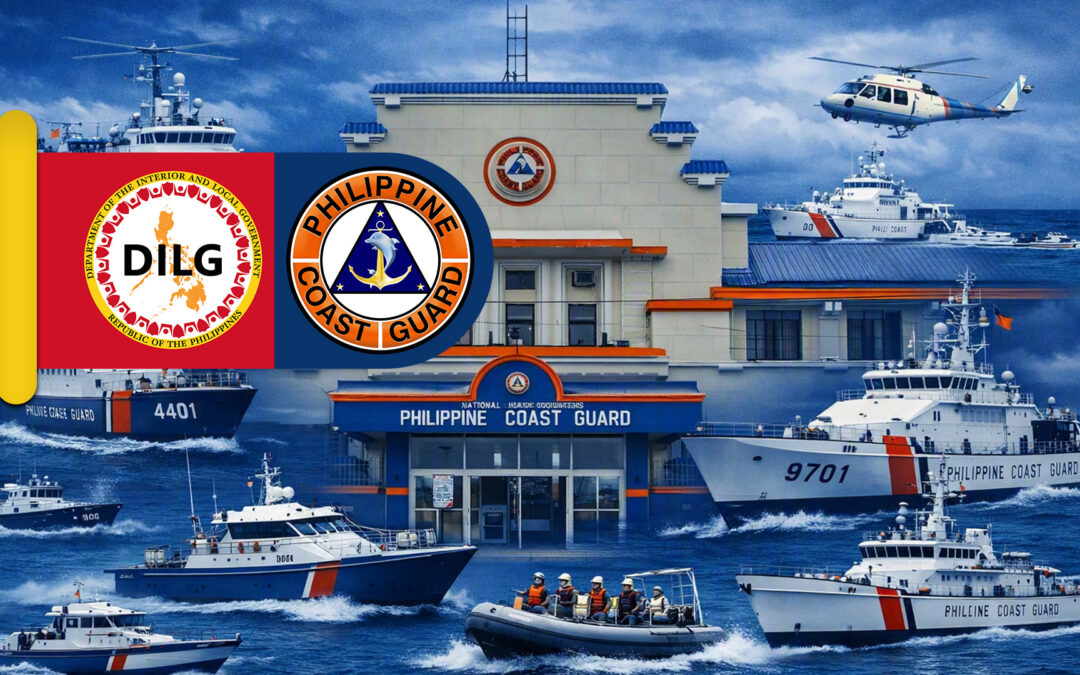
A PASLCI Perspective on the Proposed Transfer of the Philippine Coast Guard to the DILG
The continuing proposal to transfer the Philippine Coast Guard (PCG) from the Department of Transportation (DOTr) to the Department of the Interior and Local Government (DILG) should not be viewed simply as a question of administrative reorganization. At its core, it is a question of which institutional arrangement will best strengthen Philippine maritime governance.
Interior Secretary Jonvic Remulla has argued that placing the PCG under the DILG could rationalize maritime law enforcement, eliminate overlapping functions, and enable the PCG to assume a more unified maritime law-enforcement role. The proposal has also raised the possibility of consolidating or abolishing the PNP Maritime Group if the PCG becomes the principal maritime law-enforcement agency.
PASLCI recognizes the rationale behind greater institutional coherence. There is merit in reducing duplication, clarifying mandates, strengthening accountability, and establishing a more unified national maritime law-enforcement capability.
But these objectives must be pursued within a broader national framework.
The fundamental question is not simply: Should the PCG be under DOTr or DILG?
The more important question is:
Which institutional home will enable the Philippines to govern, protect, secure, and sustainably develop its entire maritime domain?
The PCG Is More Than a Maritime Police Force
The answer requires recognition of the unique character of the PCG.
Under Republic Act No. 9993, the Philippine Coast Guard Law of 2009, the PCG’s responsibilities extend well beyond conventional maritime law enforcement. Its mandate encompasses maritime safety and security, search and rescue, vessel inspection, aids to navigation, vessel traffic management, marine environmental protection, port State control, maritime communications, and other responsibilities arising from Philippine law and international maritime obligations.
These functions distinguish the PCG fundamentally from the Philippine National Police, Bureau of Fire Protection, and Bureau of Jail Management and Penology.
The PCG operates across an extensive maritime domain involving international navigation, commercial shipping, marine environmental protection, maritime safety, sovereign rights, national security, the West Philippine Sea, and Philippine Archipelagic Sea Lanes.
Its ships, aircraft, helicopters, maritime surveillance systems, communications infrastructure, navigation systems, rescue platforms, and other capabilities are therefore not merely police assets. They are instruments of national maritime governance.
This distinction should guide any decision regarding its institutional home.
Institutional Home Must Follow the Mission
DILG has legitimate institutional strengths. It has extensive experience in managing uniformed public-safety organizations, particularly in personnel administration, discipline, training, organizational oversight, and domestic law-enforcement coordination.
These strengths could potentially contribute to strengthening the PCG.
However, institutional consolidation should not become an end in itself.
The PCG’s requirements are substantially different from those of conventional domestic public-safety agencies. It requires sustained investment in vessels, aircraft, maritime surveillance, communications, aids to navigation, vessel traffic management systems, search-and-rescue platforms, environmental response capabilities, and other specialized maritime infrastructure.
Consequently, the institutional home of the PCG should be determined by the mission it performs—not merely by administrative convenience.
If DILG can provide an institutional environment that protects and enhances these requirements while strengthening accountability and law-enforcement coordination, then the proposal deserves serious consideration.
If, however, transferring the PCG would unintentionally subordinate its broader maritime responsibilities to a framework primarily designed around domestic public safety and internal security, then the transfer could weaken rather than strengthen national maritime governance.
The Critical Issue: Institutional Safeguards
For PASLCI, therefore, the decisive issue is not the name of the department but the institutional safeguards that must accompany any transfer.
If the PCG is transferred to DILG, it must retain:
- a distinct professional maritime identity;
- a nationally controlled professional chain of command;
- operational independence from local political considerations;
- protected and dedicated maritime modernization and capability-development funding;
- its complete multi-mission mandate;
- direct institutional connectivity with DOTr, MARINA, PPA, DFA, DND, AFP, DENR and other maritime and national-security agencies;
- its responsibilities in the West Philippine Sea and other strategic maritime areas; and
- its wartime attachment to the Department of National Defense as provided under Section 2 of RA 9993.
Particular care must also be taken to ensure that the local operational-supervision framework applicable to PNP units under Republic Act No. 6975 is not automatically extended to the PCG.
A Coast Guard unit responding to a maritime emergency, conducting search and rescue, enforcing maritime regulations, protecting fisheries, responding to marine pollution, or operating in the West Philippine Sea must be able to make professional operational decisions based on national law, maritime conditions, mission requirements, and the national interest—not local political considerations.
Choosing the Right Institutional Home
PASLCI does not oppose institutional reform, nor does it argue that the present DOTr arrangement should remain unchanged regardless of its shortcomings.
The current arrangement itself can and should be strengthened.
At the same time, a transfer should not be considered an improvement merely because it achieves administrative consolidation.
The appropriate test should be whether the proposed institutional home will produce a stronger Coast Guard and a stronger maritime governance system.
This means that Congress and the Executive should first establish the institutional architecture, authorities, funding mechanisms, accountability arrangements, and inter-agency relationships necessary to protect the PCG’s unique mandate.
If those safeguards can be guaranteed under DILG, then the transfer can be evaluated on its merits.
If they cannot, PASLCI believes that the PCG would be better served by remaining under DOTr while pursuing comprehensive reforms to strengthen governance, accountability, operational effectiveness, modernization, and maritime capability.
Thus, the choice should not be reduced to DOTr versus DILG.
It should be a choice between a weak institutional arrangement and a stronger institutional arrangement that genuinely serves Philippine maritime interests.
PASLCI’s Position
PASLCI supports the rationalization of maritime law enforcement.
It supports eliminating unnecessary duplication between the PCG and the PNP Maritime Group.
It supports stronger accountability, professionalization, institutional reform, and a clearer division of responsibilities among government agencies.
But maritime law enforcement must not come at the expense of maritime governance.
The Philippines is an archipelagic and maritime nation. Its maritime interests extend from domestic waters to international shipping routes, strategic sea lanes, marine resources, environmental protection, maritime security, and areas of national concern such as the West Philippine Sea.
The PCG therefore requires an institutional home capable of supporting—not constraining—the full breadth of these responsibilities.
The ultimate objective should be to build a Coast Guard that is professionally independent, operationally capable, adequately funded, nationally coordinated, internationally compliant, and fully integrated into the country’s maritime governance architecture.
The Choice Must Serve the Maritime Nation
The institutional question should never be reduced to which department can exercise greater administrative control over the PCG.
The real question is:
Which institutional home will give the Philippines the strongest Coast Guard and, ultimately, the strongest maritime governance system?
The PCG should not become merely a larger maritime police organization.
It must remain what the Philippines requires it to be: a professional, multi-mission national maritime service capable of protecting life at sea, enforcing maritime law, ensuring maritime safety and security, protecting the marine environment, supporting national security, fulfilling international obligations, and protecting Philippine maritime interests—including in the West Philippine Sea.
The institutional home must therefore follow the mission.
Rationalize maritime law enforcement—but choose the institutional home that strengthens, rather than diminishes, Philippine maritime governance.
References
- Philippine News Agency, “Remulla backs transfer of PCG, BI to DILG for faster law enforcement,” 10 September 2026.
- Republic Act No. 9993, Philippine Coast Guard Law of 2009, Sections 2–3.
- Republic Act No. 6975, Department of the Interior and Local Government Act of 1990, particularly Section 51.
- Executive Order No. 477, transferring the PCG to the Department of Transportation and Communications and affirming its maritime safety and marine-environment protection functions.
- Department of Budget and Management, National Budget Circular No. 600 (2026).
First and foremost any Coast Guard in the world MUST be the Port State Control administrator of her country whose function includes;
– Search & rescue ops
– Maritime safety & security
– Adherence to national laws and the IMO issuances for member states.
– Marine environmental protection
– Navigational safety re: bouys, VTMS, etc…
– Ensuring safety of lives at sea
– Provision of maritime advisories
– Promotion of best practices against crime / piracy at sea
– All other functions as specified as member state of the Tokyo MOU for Port State Control.in Asia and the Pacific Rim. The holistic functions therefore behooves not only the domestic and territorial seas but in harmony with global Maritime regimen that governs all member economies.
THE PHILIPPINE COAST GUARD SHOULD REMAIN UNDER THE DEPARTMENT OF TRANSPORTATION
As a retired Philippine Coast Guard personnel who dedicated 31 years of service to our country, I fully support the position that the Philippine Coast Guard (PCG) should remain under the Department of Transportation (DOTr).
The PCG is more than a law-enforcement agency. It is a multi-mission maritime service entrusted with protecting lives at sea, ensuring maritime safety, conducting search and rescue, protecting our marine environment, maintaining aids to navigation, supporting maritime security, and enforcing maritime laws.
Yes, the PCG must work closely with the DILG, PNP, AFP, DOJ, DENR, BFAR and other government agencies. But strong coordination does not necessarily require organizational transfer.
The PCG has developed its own professional identity, expertise and maritime capabilities. Moving it to another department should not be undertaken simply because some of its functions involve law enforcement. We must look at the whole mission of the Coast Guard, not just one part of it.
After 31 years of wearing the PCG uniform, I believe that the Coast Guard’s future should be guided by its primary character as a national maritime service—protecting our people, our seas, our maritime interests and our nation.
Let us strengthen the PCG, provide it with the assets and resources it needs, improve inter-agency coordination, and continue building a world-class Coast Guard—without losing the institutional identity that has made it an essential part of our maritime nation.
Keep the Philippine Coast Guard under DOTr.
Strengthen—not weaken—our Coast Guard.
⚓ Para sa Bayan. Para sa Dagat. Para sa Sambayanang Pilipino.
Semper Paratus!