
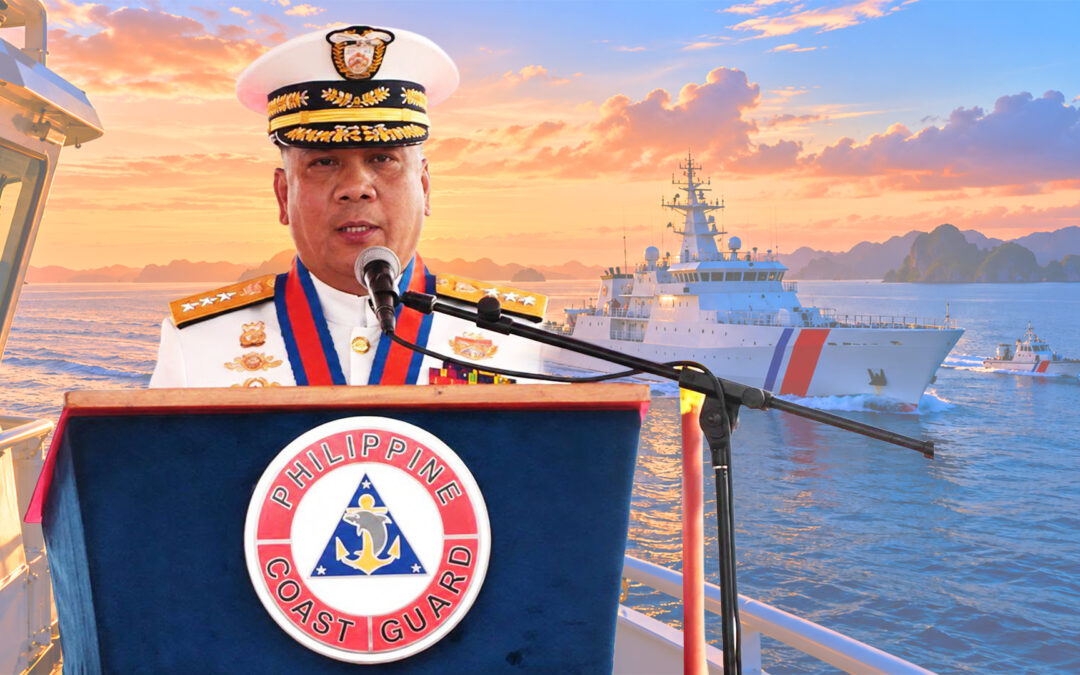
Four Strategic Pillars, One Compass: A Stronger, More Accountable, and Future-Ready Coast Guard
On 19 October 2026, the nation witnessed an important milestone in the history of the Philippine Coast Guard (PCG). At the change-of-command and retirement ceremony presided over by President Ferdinand R. Marcos Jr., Admiral Ronnie Gil Gavan relinquished his position to Vice Admiral Rommel A. Supangan, the newly installed 31st Commandant of the PCG. Admiral Gavan’s retirement marked the end of his tenure, while VADM Supangan’s assumption of command opened another chapter in the continuing story of the service.
For those of us who have devoted much of our lives to the Coast Guard, moments like this bring mixed emotions. We look back with gratitude at the service and sacrifices of the outgoing leadership, but we also look forward with hope to the opportunities and challenges that await the new Commandant.
A member of Philippine Military Academy Marilag Class of 1995, VADM Supangan brings more than three decades of experience in the PCG, including leadership roles in maritime operations, environmental protection, and strategic affairs. His professional background and known advocacy of the Performance Governance System (PGS) have raised expectations that his administration will pursue meaningful reforms in governance, organizational performance, and personnel development.
But what impressed me most after hearing the four strategic pillars he laid down for his command was the opportunity they present to strengthen not only the organization, but also the way we govern and protect our maritime domain.
Equally significant is his reference to a Compass as the strategic roadmap for steering the PCG toward its desired future. A clear direction is essential for any organization, but direction alone is not enough. The real challenge is to translate a commander’s vision into institutional priorities, concrete actions, measurable results, and lasting improvements in organizational performance.
My impression is one of hope and cautious optimism. The four pillars reflect an understanding that a strong Coast Guard must be built from within, perform effectively at sea, invest in its people and capabilities, and work closely with others who share responsibility for our nation’s maritime future. The Compass provides the strategic orientation that should keep these efforts aligned, focused, and moving toward a common destination.
Four Pillars, One Compass, One Direction
The four strategic pillars establish the principal areas of focus for the new administration. The Compass, as the strategic roadmap, should help ensure that these priorities are translated into coordinated programs, clear performance standards, and measurable accomplishments.
The First Pillar: Institutional Transformation and Good Governance
The first pillar, Institutional Transformation and Good Governance, strikes at the heart of organizational reform. Good governance begins with leadership by example. Transparency, accountability, discipline, and integrity must be evident in everyday decisions, from headquarters down to the smallest operational unit.
Having served in the organization for more than three decades, I believe that our people perform best when expectations are clear, standards are consistently enforced, and merit is recognized. If the new administration can translate its strategic direction into measurable performance and genuine accountability, it can help build a stronger institutional culture.
In this regard, the Compass must serve as more than a statement of intent. It should guide the development of clear command priorities, performance indicators, and accountability mechanisms that enable every unit and personnel to understand their responsibilities and contribute to organizational objectives.
Institutional transformation becomes meaningful when good governance is not merely a policy but a way of life throughout the organization.
The Second Pillar: Effective Maritime Governance
The second pillar, Effective Maritime Governance, reminds us why the PCG exists: to protect lives at sea, safeguard the marine environment, enforce applicable maritime laws, and contribute to the protection of our national maritime interests.
The Commandant’s reported declaration, “We will stand on what is ours, and we will do so with dignity, integrity, and absolute resolve,” conveys a firm commitment to protecting Philippine sovereign rights, particularly in the West Philippine Sea. Such resolve must be matched by professionalism, sound judgment, and steadfast adherence to international law.
The Compass should help ensure that operational priorities, maritime domain awareness, navigational safety, environmental protection, and the protection of national maritime interests reinforce one another.
For an archipelagic nation such as the Philippines, effective maritime governance requires more than the presence of vessels at sea. It demands a coordinated system of institutions, information, capabilities, and policies that enables the government to understand, manage, and protect its maritime domain.
The Third Pillar: Modernization and Capacity Building
The third pillar, Modernization and Capacity Building, recognizes that ships and equipment alone do not make an effective Coast Guard. Our greatest asset remains our people. Modern platforms and advanced technologies must be matched by competent personnel, continuous training, sound leadership, and the discipline to use those capabilities effectively.
The Compass should guide modernization toward operational requirements and measurable improvements in mission effectiveness. Investments in vessels, communications, maritime surveillance, information systems, and other capabilities should respond to clearly identified needs and support the PCG’s long-term strategic objectives.
Equally important is the professional development of officers and enlisted personnel. Modernization must be accompanied by a deliberate effort to develop competent leaders, strengthen technical expertise, improve institutional knowledge, and prepare the next generation of Coast Guard professionals.
Ultimately, the success of modernization should not be measured solely by the number of assets acquired, but by the improvements in readiness, responsiveness, safety, and service delivery that these investments produce.
The Fourth Pillar: Strategic Partnerships and Cooperation
The fourth pillar, Strategic Partnerships and Cooperation, acknowledges a simple truth: no single agency can address every maritime challenge alone. Stronger collaboration among government institutions, international partners, maritime industries, and academic organizations will be essential to advancing our national maritime interests.
The Compass should provide a common strategic direction for these partnerships, ensuring that cooperation produces tangible outcomes rather than isolated activities.
Closer coordination among the PCG, Department of Transportation (DOTr), Department of Foreign Affairs (DFA), National Mapping and Resource Information Authority (NAMRIA), Department of National Defense (DND), and other concerned agencies can help address institutional gaps and improve the delivery of maritime services.
Partnerships with the private sector, research institutions, and international organizations can also contribute technical expertise, innovative solutions, and opportunities for capacity development.
Taken together, the four pillars establish a promising direction for the PCG. The Compass should keep the organization focused on that direction, while the results achieved on the ground will ultimately determine the success of the new administration.
Where Philippine Archipelagic Sea Lanes Fit In
For the Philippine Archipelagic Sea Lanes Center Inc. (PASLCI), these priorities resonate strongly with our advocacy.
Republic Act No. 12065, or the Philippine Archipelagic Sea Lanes Act, provides the legal framework for establishing archipelagic sea lanes in Philippine waters. Together with the United Nations Convention on the Law of the Sea (UNCLOS), particularly Articles 53 and 54, it establishes the foundation for pursuing the applicable national and international processes for ASL designation and implementation. Article 53 specifically provides for proposals to be referred to the competent international organization for adoption.
The institutionalization and operationalization of Philippine Archipelagic Sea Lanes (ASL) can complement all four pillars of the new Commandant’s leadership and contribute to the strategic direction embodied in his Compass.
It supports good governance by encouraging clearer institutional responsibilities, coordinated planning, and measurable implementation objectives. It advances effective maritime governance by providing a framework for addressing navigational safety and vessel movements. It creates opportunities for modernization and capacity building through the development of appropriate maritime monitoring systems, technical expertise, and operational capabilities. Finally, it strengthens strategic partnerships by requiring cooperation among the PCG, DOTr, NAMRIA, DFA, and other concerned agencies.
The development of Vessel Traffic Management Systems (VTMS), supported by proper feasibility studies and technical assessments, can complement these efforts by improving maritime awareness, supporting navigational safety, and strengthening incident response.
These initiatives are particularly relevant to the Philippines, whose geography presents both a strategic advantage and a substantial governance responsibility. Our archipelagic waters connect communities, sustain commerce, facilitate international navigation, and support the livelihoods of millions of Filipinos. Their effective management requires a coordinated approach that integrates maritime safety, environmental protection, navigational information, and national policy.
PASLCI stands ready to contribute through research, policy development, technical collaboration, and stakeholder engagement in support of the government’s efforts.
Our purpose is not to create another layer of bureaucracy. It is to help bring institutions together around a common national objective: a safer, better-governed, and more capable maritime Philippines.
By aligning our advocacy with the Commandant’s strategic priorities, we hope to contribute constructively to the government’s efforts to strengthen maritime governance and advance the responsible implementation of the Philippine Archipelagic Sea Lanes Act.
The Real Test Begins Now
In accepting the responsibility of command, VADM Supangan reportedly described it as a “profound sense of humility, gravity, and sacred duty.” These words resonate deeply with those who have worn the uniform. Command is more than authority or rank. It is a responsibility to care for one’s people, make difficult decisions, uphold professional standards, and remain accountable for the institution entrusted to one’s leadership.
The coming months will reveal how these four pillars and the Compass translate into command guidance, organizational reforms, operational improvements, and stronger personnel development. The expectations are high, but so is the opportunity.
A strategic roadmap becomes meaningful when it guides actual decisions. The Compass must therefore be reflected in the Commandant’s priorities, the allocation of resources, the assignment and development of personnel, the evaluation of unit performance, and the consistent enforcement of professional standards.
The organization must also understand that transformation is a continuing process. It requires clear communication, disciplined execution, regular assessment, and the willingness to make adjustments when circumstances demand them.
For those of us who have retired from active service, our journey does not necessarily end with the surrender of our command. We may leave our positions, but our commitment to public service and the welfare of the institution remains.
As VADM Supangan takes the helm, I hope he will build on the PCG’s institutional strengths, address its continuing challenges, and inspire every Coast Guard officer and enlisted personnel to serve with integrity, competence, and compassion.
A new dawn of leadership is not defined by a change of command alone. It begins when a vision becomes action, when a strategic roadmap provides direction, when accountability becomes a culture, and when reforms translate into better service for our people.
The four pillars establish the priorities. The Compass provides the strategic direction. Leadership, discipline, and collective commitment must turn them into lasting institutional achievements.
The voyage continues. May this new chapter bring a stronger Coast Guard, a more secure maritime domain, and a renewed commitment to service to God, country, and the Filipino people.
One Maritime Nation. Shared Purpose. Shaping Our Maritime Future.
References
- Philippine News Agency. (19 October 2026). Rommel Supangan named new PCG commandant.
- Philippine Information Agency. (19 October 2026). President Marcos names Vice Admiral Supangan as new PCG commandant.
- Daily Tribune. (19 October 2026). New PCG chief vows unwavering defense of West Philippine Sea.
- PortCalls Asia. (19 October 2026). Supangan is new Philippine Coast Guard commandant.
- Republic Act No. 12065. Philippine Archipelagic Sea Lanes Act. Supreme Court E-Library.
- United Nations. United Nations Convention on the Law of the Sea, Part IV: Archipelagic States, Articles 53–54.
- Republic Act No. 12122. An Act Fixing the Term of Office of the Philippine Coast Guard Commandant and for Other Purposes. LawPhil.