
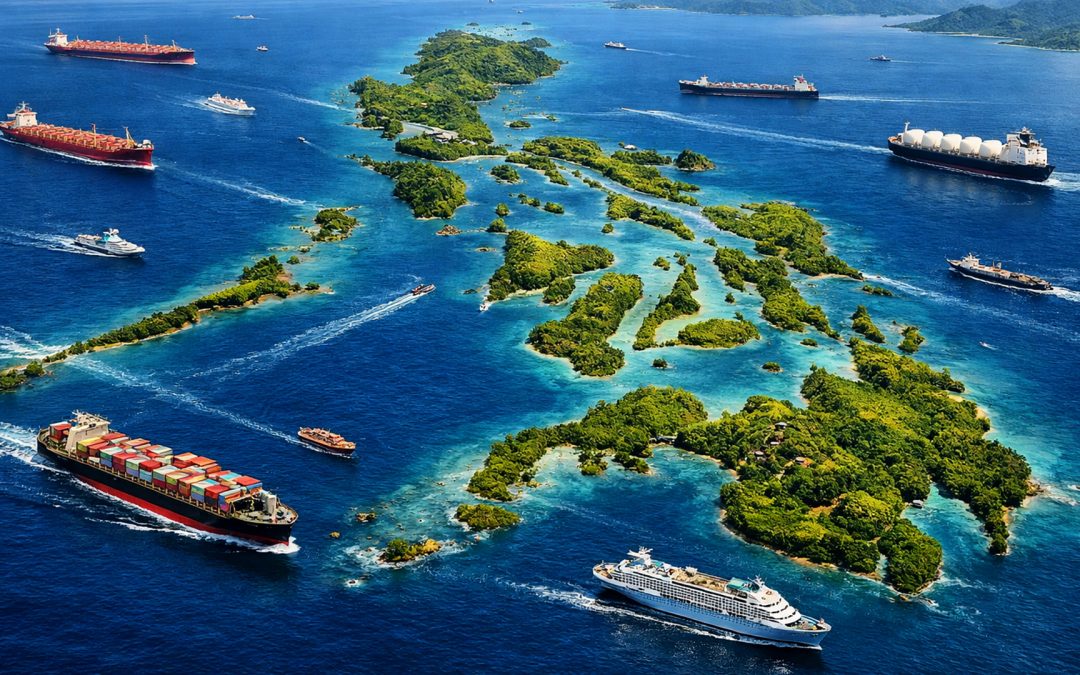
As one of the world’s largest archipelagic nations, the Philippines is fundamentally shaped by the sea. With more than 7,600 islands interconnected by extensive maritime corridors, the country relies heavily on safe, secure, and efficiently managed waters for trade, transportation, food security, energy supply, environmental protection, disaster response, and national defense. More than geography, the maritime domain constitutes a strategic national space that directly influences the country’s economic stability, sovereign security, and regional relevance.
Every day, thousands of domestic and international vessels traverse Philippine waters carrying essential goods, fuel, food, and commercial cargo that sustain both the national economy and global maritime trade. Many of these vessels navigate through critical maritime choke points such as the Balabac Strait, San Bernardino Strait, Surigao Strait, Sibutu Passage, Verde Island Passage, Basilan Strait, and Mindoro Strait — sea corridors that are vital not only to Philippine domestic connectivity but also to international shipping and Indo-Pacific maritime commerce.
Despite its strategic maritime location, the Philippines still lacks a fully integrated national framework for the governance and operational management of Archipelagic Sea Lanes (ASL), vessel traffic monitoring, maritime corridor protection, and coordinated maritime environmental response. Existing maritime functions remain dispersed among multiple government agencies, often resulting in fragmented coordination, overlapping mandates, operational inefficiencies, and gaps in maritime domain awareness.
Recognizing these strategic challenges, a comprehensive national maritime governance initiative is being proposed through the policy framework entitled:
“Institutionalizing and Operationalizing Philippine Archipelagic Sea Lanes (ASL) for Maritime Safety, National Resilience, and Regional Stability”
The initiative seeks to establish a long-term national maritime governance architecture that strengthens maritime safety, enhances national resilience, supports regional stability, and reinforces the Philippines’ role as a responsible archipelagic state within the Indo-Pacific region.
At its core, the proposal recognizes that Archipelagic Sea Lanes are not merely navigational corridors for international passage. Rather, they constitute strategic maritime corridors that require integrated governance, real-time maritime monitoring, infrastructure support, environmental safeguards, inter-agency coordination, and sustained national policy direction.
The initiative is anchored on the Philippines’ rights and obligations under the United Nations Convention on the Law of the Sea (UNCLOS), particularly the provisions relating to archipelagic states and archipelagic sea lanes passage. It likewise aligns with the standards and objectives of the International Maritime Organization (IMO), the Philippine Maritime Zones Act, the National Security Policy, maritime safety frameworks, environmental protection commitments, and the country’s Blue Economy aspirations.
More importantly, the initiative elevates ASL governance beyond traditional maritime administration by positioning it as a strategic instrument for:
- Maritime Safety,
- National Security,
- Economic Resilience,
- Maritime Domain Awareness,
- Environmental Protection,
- Disaster Preparedness,
- and Regional Maritime Stability.
One of the key components of the initiative is the proposed creation of an Inter-Agency National Archipelagic Sea Lanes Council. The proposed Council would initially serve as the government’s central coordinating mechanism for ASL governance, policy harmonization, and implementation planning.
The Council would bring together key maritime and security agencies including the Philippine Coast Guard, MARINA, NAMRIA, Armed Forces of the Philippines, Bureau of Fisheries and Aquatic Resources, Bureau of Customs, Department of Transportation, Department of Environment and Natural Resources, Department of Energy, and other relevant stakeholders.
Its principal mandate would be to:
- Harmonize National Maritime Policies,
- Coordinate Strategic Maritime Planning,
- Integrate Maritime Operational Systems,
- Develop ASL Governance Mechanisms,
- Establish Maritime Corridor Management Protocols,
- and Strengthen Inter-agency Maritime Coordination.
Importantly, the proposed Council is envisioned as a transitional institutional mechanism that may later evolve into a permanent National Archipelagic Sea Lanes Authority (NASLA). This phased approach allows the government to gradually establish the legal, technical, operational, administrative, and financial foundations necessary for long-term ASL governance while ensuring flexibility and practical implementation.
The eventual transition toward a National Archipelagic Sea Lanes Authority reflects the recognition that ASL governance is not a temporary administrative undertaking but a long-term strategic national function requiring sustained institutional capability, centralized coordination, infrastructure oversight, maritime analytics, and operational continuity.
Another major component of the initiative is the proposed establishment of a National Vessel Traffic Management System (VTMS) covering strategic maritime choke points and designated ASL corridors.
Comparable to air traffic management systems in aviation, the proposed VTMS would provide real-time monitoring and management of vessel movement across critical maritime routes. The system would enhance navigational safety, improve maritime traffic efficiency, strengthen maritime security surveillance, support search and rescue operations, reduce collision risks, and significantly improve national maritime domain awareness.
The proposed VTMS would also contribute to:
- Safer Domestic Shipping,
- More Efficient Maritime Commerce,
- Improved Incident Response,
- Enhanced Protection of Strategic Maritime Infrastructure,
- and Better Monitoring of Activities within Critical Maritime Corridors.
For ordinary Filipinos, these benefits translate into safer seas, more reliable maritime transportation, stronger environmental protection, and improved national disaster preparedness.
Complementing these initiatives is the proposed establishment of a National Tier 2 Oil Spill Response Organization (OSRO). Recognizing that increased maritime activity correspondingly increases environmental risks, the proposed OSRO capability seeks to establish a nationally coordinated rapid-response system for medium-scale oil spill incidents and maritime environmental emergencies.
Oil spills pose significant threats to marine ecosystems, fisheries, tourism industries, coastal communities, and national economic corridors. Through a coordinated OSRO capability integrated with Philippine Coast Guard marine environmental protection systems, the country would significantly improve its ability to respond rapidly and effectively to maritime environmental incidents.
Beyond maritime safety and environmental protection, the broader significance of the initiative lies in its contribution to national resilience and strategic governance.
The Philippines occupies a central position within one of the world’s most dynamic and strategically contested maritime regions. As geopolitical competition, international shipping activity, and maritime security challenges continue to increase across the Indo-Pacific, the country must strengthen its capacity to govern, monitor, secure, and protect its maritime spaces responsibly and effectively.
The proposed initiative therefore represents far more than a transportation or maritime administration program. It constitutes a long-term national strategy aimed at:
- Strengthening Maritime Governance,
- Enhancing Maritime Safety,
- Improving National Security,
- Protecting Marine Ecosystems,
- Supporting Economic Development,
- Strengthening Disaster Resilience,
- Improving Inter-agency Coordination,
- and Reinforcing the Philippines’ Role in Regional Maritime Stability.
Ultimately, the initiative seeks to transform fragmented maritime administration into an integrated national maritime governance system befitting the Philippines’ strategic maritime identity as a major archipelagic and Indo-Pacific nation.
For the Filipino people, this means safer seas, stronger environmental protection, more secure maritime trade routes, improved disaster preparedness, enhanced maritime security, and a more resilient nation capable of safeguarding its maritime interests for future generations.
References
- United Nations Convention on the Law of the Sea (UNCLOS), 1982.
- International Maritime Organization (IMO) Maritime Safety Frameworks and Conventions.
- Republic Act No. 12064 – Philippine Maritime Zones Act.
- Philippine Coast Guard Maritime Safety and Marine Environmental Protection Programs.
- Department of Transportation Maritime Transport Development Policies.
- National Security Council National Security Policy Framework.
- Maritime Industry Authority Maritime Industry Development Programs.
- National Mapping and Resource Information Authority Hydrographic and Maritime Mapping Programs.
- Philippine Blue Economy and Maritime Governance Policy Initiatives.