
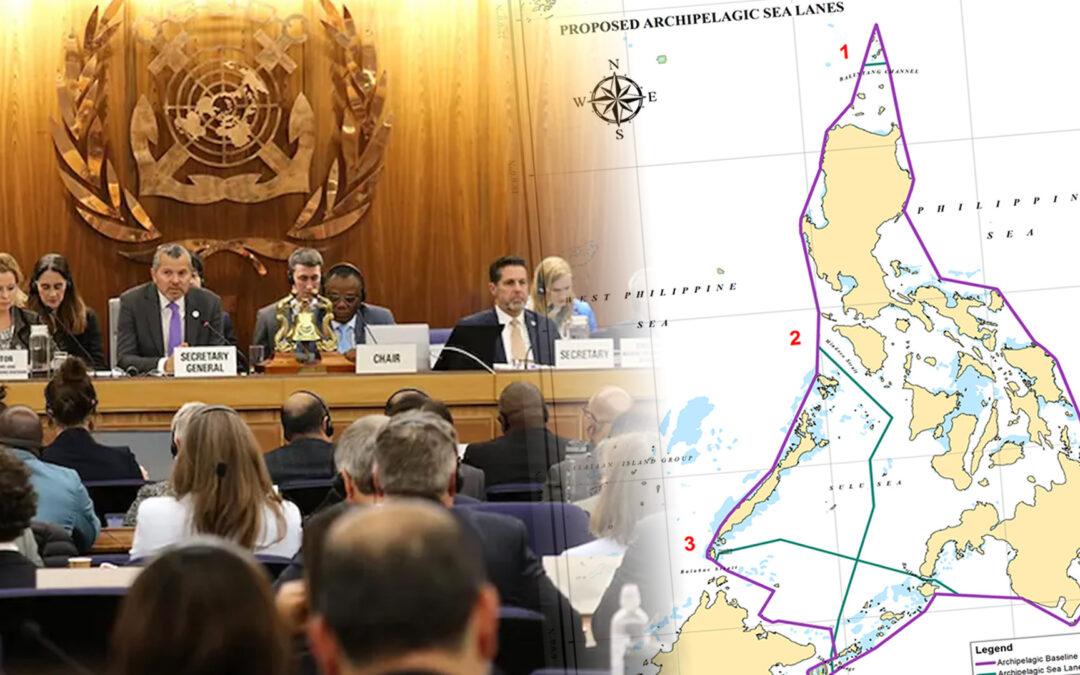
As an archipelagic state under the United Nations Convention on the Law of the Sea (UNCLOS), the Philippines holds the sovereign right to designate Archipelagic Sea Lanes (ASLs) through which foreign vessels and aircraft may exercise the right of archipelagic sea lanes passage. This process balances national security interests with the international community’s need for safe and uninterrupted navigation. Indonesia remains the only state to have successfully designated ASLs through the International Maritime Organization (IMO), making its experience a valuable model for the Philippines.¹ From this benchmark, the Philippines can identify the technical, legal, diplomatic, and institutional imperatives necessary for securing the adoption of Philippine Archipelagic Sea Lanes (PASLs).
Indonesia’s Experience: A Benchmark for Success
Indonesia’s successful designation of ASLs did not occur overnight; it was the product of extensive hydrographic surveys, sustained diplomatic engagement, interagency coordination, and meticulous compliance with UNCLOS provisions.² Indonesia’s proposal also benefited from strong regional consultation and a coherent domestic maritime governance structure that enabled it to speak to the IMO with a unified national voice.³
The Philippines, seeking similar recognition, must follow this proven pathway while addressing its own unique maritime challenges.
Technical Imperatives: Mapping, Safety, and IMO-Standard Routeing
For IMO approval, an ASL proposal must demonstrate that proposed routes are safe, navigable, and appropriate for continuous and expeditious passage. Indonesia achieved this by delivering comprehensive hydrographic and oceanographic data, designing internationally compliant traffic separation schemes (TSS), and conducting navigational risk assessments.⁴
The Philippines must therefore:
- Conduct complete hydrographic surveys, including depth mapping, current profiling, seabed characterization, and traffic-density analysis.
- Develop IMO-compliant routeing measures, such as two-way routes, TSS, and precautionary areas.⁵
- Provide environmental and navigational risk assessments, especially in ecologically sensitive zones.
- Show data-based justification that proposed PASLs are consistent with UNCLOS’ requirement for continuous and expeditious passage.⁶
Without these, IMO approval is improbable, regardless of diplomatic effort.
Legal Imperatives: Full Alignment With UNCLOS
Legal coherence was fundamental to Indonesia’s success. Its baselines, navigation rules, and ASL proposals closely followed UNCLOS Part IV.
For the Philippines, the legal imperatives include:
- Ensuring the legality of baselines under RA 9522 and their consistency with UNCLOS.⁷
- Harmonizing domestic regulations with UNCLOS Article 53, which prohibits imposing requirements that hinder archipelagic sea lanes passage.⁸
- Clarifying operational rules for foreign vessels, including military ships and submarines, in a manner that respects international law.⁹
Any legal inconsistencies may result in objections at the IMO, particularly from maritime powers that guard freedom of navigation.
Diplomatic Imperatives: Engaging the IMO and Maritime Powers
IMO adoption is a political process as much as a technical one. Indonesia’s success was supported by extensive diplomatic consultations with key maritime states, including the United States, Japan, and China.¹⁰
For the Philippines, the diplomatic requirements include:
- Early engagement with IMO technical committees and subcommittees.
- Pre-submission consultations with major maritime nations that may raise freedom-of-navigation concerns.¹¹
- Securing ASEAN support, which helps prevent competing claims or overlapping lane proposals.
- Preparing responses to possible objections related to the West Philippine Sea and regional security dynamics.
Diplomacy determines whether the Philippines’ technical work will translate into international approval.
Domestic Governance Imperatives: A Unified National Strategy
Indonesia benefited from a highly centralized maritime governance structure. In contrast, the Philippines’ fragmented institutional landscape—spanning the DFA, DOTr, PCG, PN, MARINA, NAMRIA, and others—creates challenges.
To succeed, the Philippines must:
- Create a single empowered lead agency or task force to steer the PASL project.¹²
- Strengthen interagency coordination to ensure consistent data and policy.
- Improve maritime domain awareness (MDA) capabilities such as AIS coverage, surveillance, and incident response.¹³
IMO approval requires assurance that the Philippines can manage, monitor, and enforce safety in designated sea lanes.
Security and Strategic Imperatives: Balancing Rights and National Protection
UNCLOS allows foreign ships—including warships and submarines—to pass through ASLs without prior notification.¹⁴ This raises security concerns for archipelagic states.
To balance these concerns while maintaining UNCLOS compliance, the Philippines must:
- Develop clear rules and protocols that respect passage rights while safeguarding national security.
- Enhance search-and-rescue (SAR) and disaster-response capacity.
- Build maritime safety infrastructure, such as navigational aids and response vessels.
- Use PASLs as a means to ensure predictable, monitorable routes rather than unrestricted movement across all archipelagic waters.¹⁵
By providing structured pathways, PASLs can serve as both a legal obligation and a strategic advantage.
Conclusion: A Strategic Opportunity for a Maritime Nation
Securing IMO adoption of the Philippine Archipelagic Sea Lanes represents a significant strategic step. It would affirm Philippine stewardship over its waters, strengthen maritime security, enhance environmental protection, and fulfill its responsibilities as an archipelagic state. Indonesia’s experience shows that this goal is attainable—but only through comprehensive technical preparation, legal clarity, diplomatic engagement, and a unified national strategy.
For the Philippines, the adoption of PASLs is not merely a bureaucratic task. It is a defining project of maritime nationhood—one that requires vision, discipline, and strategic coordination across all sectors of government.
Footnotes
- Sam Bateman, Archipelagic Sea Lanes in Indonesia: Their Importance for the International Maritime Community.
- Mark J. Valencia, Indonesia and the Law of the Sea: The Struggle for Archipelagic Statehood.
- Clive Schofield and Sam Bateman, Hydrographic and Maritime Boundary Issues in the Archipelagic Context.
- International Maritime Organization (IMO), General Provisions on Ships’ Routeing (GPSR).
- IMO, Guidance on the Submission of Archipelagic Sea Lanes Proposals to the Sub-Committee on Safety of Navigation.
- United Nations, United Nations Convention on the Law of the Sea (UNCLOS), 1982.
- Republic Act No. 9522, An Act to Amend the Baselines Law of the Philippines.
- UNCLOS, art. 53.
- Clive Schofield, Maritime Claims, UNCLOS, and the Archipelagic Regime.
- Valencia, Indonesia and the Law of the Sea.
- Bateman, Archipelagic Sea Lanes in Indonesia.
- Schofield and Bateman, Hydrographic and Maritime Boundary Issues in the Archipelagic Context.
- Bateman, Archipelagic Sea Lanes in Indonesia.
- UNCLOS, Part IV.
- IMO, Guidance on the Submission of Archipelagic Sea Lanes Proposals.
References
Bateman, Sam. Archipelagic Sea Lanes in Indonesia: Their Importance for the International Maritime Community. Canberra: Australian National Centre for Ocean Resources and Security (ANCORS).
Bateman, Sam, and Clive Schofield. Hydrographic and Maritime Boundary Issues in the Archipelagic Context. Wollongong: ANCORS, University of Wollongong.
International Maritime Organization (IMO). General Provisions on Ships’ Routeing (GPSR). London: IMO.
International Maritime Organization (IMO). Guidance on the Submission of Archipelagic Sea Lanes Proposals to the Sub-Committee on Safety of Navigation. London: IMO.
Republic Act No. 9522. An Act to Amend the Baselines Law of the Philippines. Manila: Congress of the Philippines.
Schofield, Clive. Maritime Claims, UNCLOS, and the Archipelagic Regime. Leiden: Brill.
United Nations. United Nations Convention on the Law of the Sea (UNCLOS), 1982. New York: United Nations.
Valencia, Mark J. Indonesia and the Law of the Sea: The Struggle for Archipelagic Statehood. Singapore: Institute of Southeast Asian Studies.
Very informative…
👏👏👏👏
Congratulations on your article, Sir. Well noted on the archipelagic sea lanes Sir! 🫡
Do not dream, make it happen. The lesson from Indonesia and the imperative IMO adoption is the ideal dream path way to materialize the legal personality of the Philippine controversial territory. Hence,The PASL is a big win for the Philippines’ maritime future — it’ll boost trade, secure our waters, and open doors for economic growth.
Good day, Sir. I am also writing a thesis on ASLs, specifically on what the Philippines can draw from the Indonesian experience.
One of the things that would be very helpful for us is the agreed-upon 19 rules on the use of ASLs by Indonesia and some notable major maritime powers (United States, Australia, Japan and the United Kingdom) (Djalal, 2009).
Source: Djalal, Hasjim. “Indonesia’s Archipelagic Sea Lanes.” In Indonesia Beyond the Water’s Edge: Managing an Archipelagic State. ISEAS Publishing, 2009. 63-65
Another insightful info, Sir! You’ve clearly frame the PASLs’ on its both technical and startegic standpoint. Drawing on Indonesia’s experience on how they convinced IMO to recognize their ASL indeed shows it is feasible. Nothing will ever be easy, but with rigorous and analytical preparation, disciplined implementation and sustained efforts we can address our maritime governance challenges effectively. It will be a long road, but its about time we start doing it now.
Well written and informative article, sir. It clearly outlines the need for establishing PASLs and the complex measures needed to start the strategic task. Bravo Zulu, sir!